Best Car Rubbing Machine for Beginners in India (2026 Guide)
India sold 4.3 million passenger vehicles in FY 2024-25. Here’s how beginners should choose a safe car rubbing machine in India, plus the specs that matter most.
# Best Car Rubbing Machine for Beginners in India (2026 Guide)
India hit a record **4.3 million passenger vehicle sales in FY 2024-25**, according to SIAM ([SIAM](https://www.siam.in/pressrelease-details.aspx?mpgid=48&pgidtrail=50&pid=579), 2025). More cars on the road means more owners trying to maintain paint, remove swirls, and keep resale value healthy. And once you step past hand polish, the next question is obvious: **which rubbing machine should a beginner buy?**
If you’ve searched online, you already know the problem. Listings are crowded with terms like DA, orbital, rotary, 15 mm throw, 5-inch backing plate, 1000W, six-speed, and “professional grade.” Half the pages feel helpful. The other half feel like they were written by a bored catalog robot.
So let’s simplify it.
For beginners in India, the best car rubbing machine is usually **a dual-action (DA) polisher with a 5-inch backing plate, moderate throw, variable speed, and easy pad availability**. Not the most aggressive. Not the cheapest no-name gamble. And definitely not a rotary unless you already know exactly why you need one.
> **TL;DR:** For most first-time users in India, the best car rubbing machine is a **dual-action polisher**, not a rotary. DA machines are more forgiving, easier to control, and better suited to light-to-moderate correction on daily drivers. With India’s detailing market at **USD 3,633.4 million in 2024** and growing at **6.4% CAGR** ([Grand View Research](https://www.grandviewresearch.com/horizon/outlook/car-detailing-services-market/india), 2025), beginners should choose safety, pad ecosystem, and local support over raw cutting power.
[INTERNAL-LINK: rubbing polish vs polishing compound → guide to what products you’ll actually use with a machine polisher]
## What type of car rubbing machine is best for beginners?
Global car detailing services are estimated at **USD 42.64 billion in 2025**, with Asia Pacific the fastest-growing region, according to Mordor Intelligence ([Mordor Intelligence](https://www.mordorintelligence.com/industry-reports/car-detailing-services-market), 2025). That growth has made polishing machines easier to find, but the best beginner choice remains very clear: **a dual-action polisher is usually the safest and smartest rubbing machine for beginners.**
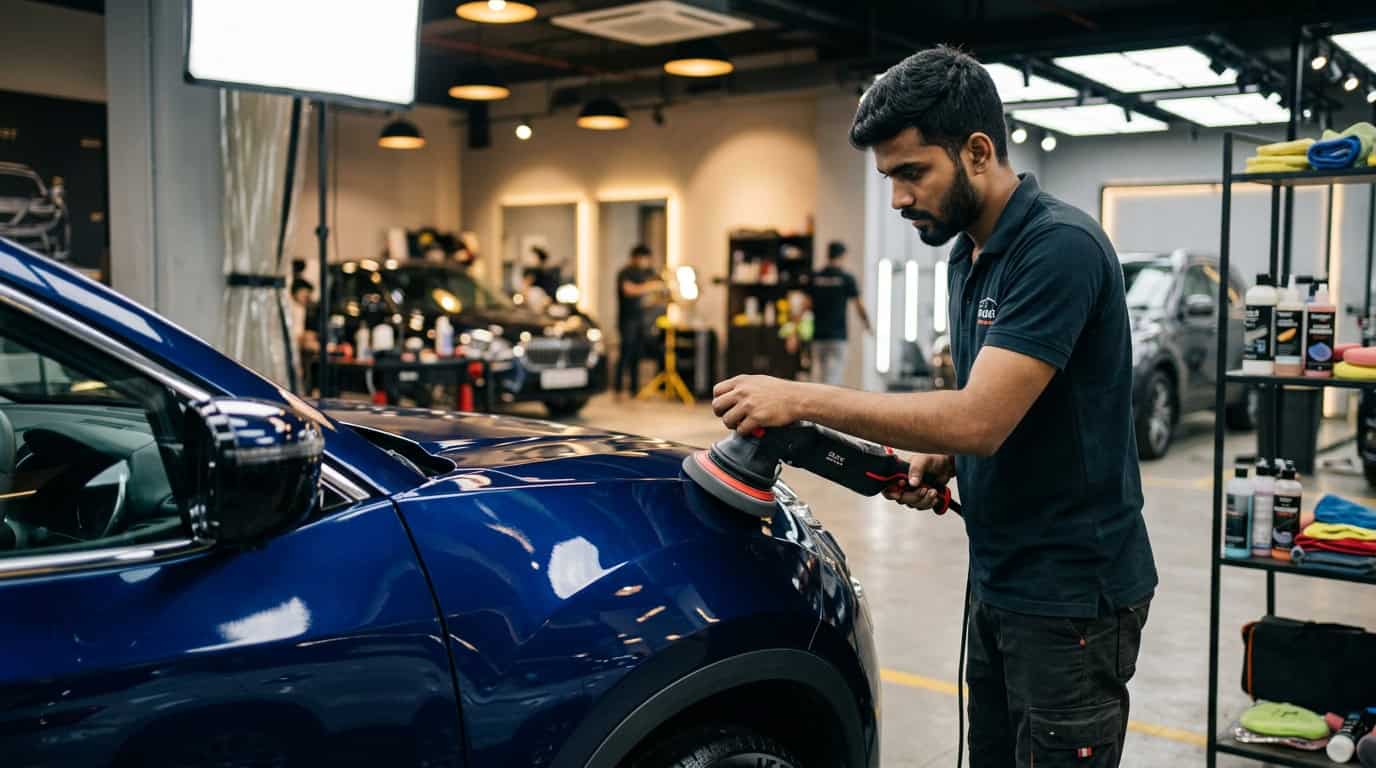
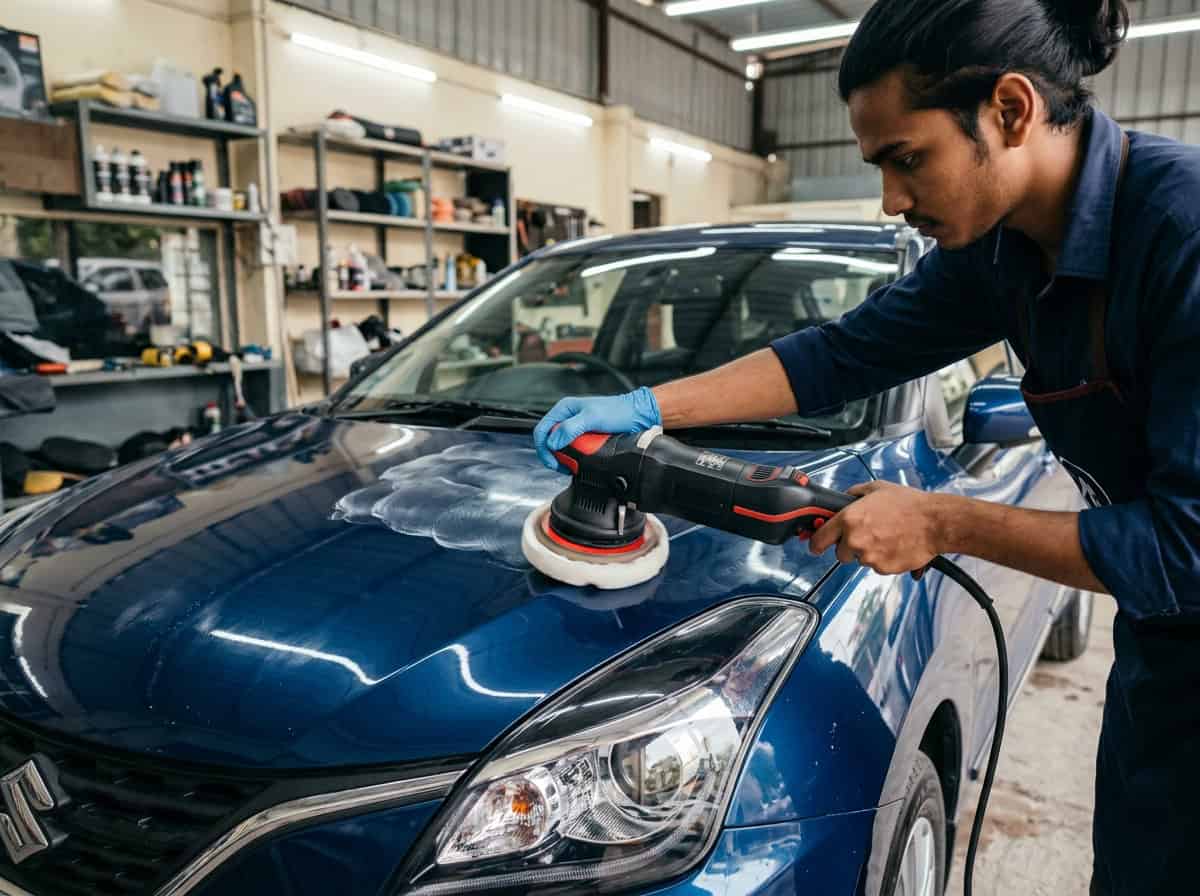
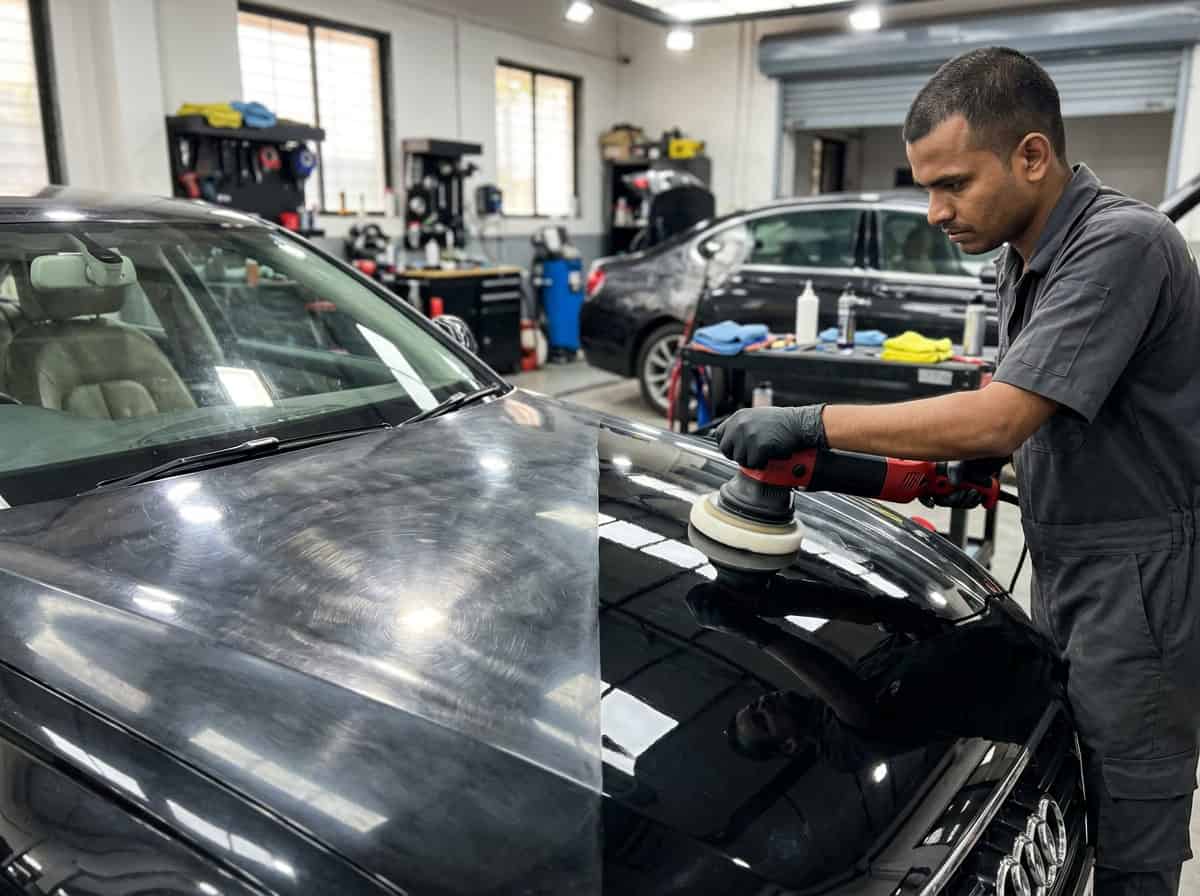
A dual-action machine both rotates and oscillates. That movement spreads friction over a wider pattern and makes it harder to burn paint compared with a rotary machine. It still needs technique, yes. But it gives you more margin for error, which is exactly what a beginner needs while learning pad pressure, arm speed, section size, and product amount.
A rotary, by contrast, spins in a direct single motion. That makes it faster at correction in experienced hands, but also more likely to overheat paint, create holograms, or punish poor technique. Ask yourself honestly: are you trying to learn safely or impress yourself dangerously? Exactly.
For most Indian owners working on hatchbacks, sedans, or compact SUVs, a DA polisher covers the sweet spot beautifully. It can handle light swirls, haze, gloss improvement, and one-step correction with far less drama than a rotary.
A beginner’s first machine should not be judged by how fast it can cut. It should be judged by how hard it is to make an expensive mistake. That’s why DA wins.
A quotable summary: **For beginners, a DA rubbing machine is better than a rotary because it balances correction power with paint safety, making it more suitable for daily drivers, softer paints, and first-time users learning the basics of machine polishing.**
[INTERNAL-LINK: paint correction for cars → deeper guide on how machine polishing fits into a safe correction workflow]
For new users, a dual-action machine offers the best balance of correction and control.
## Which specs matter most when buying a rubbing machine in India?
Amazon India listings for common enthusiast machines already show why specs matter. For example, the MaxShine M15 Pro is listed with a **1000W motor, 15 mm orbit, 125 mm/5-inch pad size, and 2200–5000 RPM** ([Amazon India](https://www.amazon.in/Pro-15mmOrbit-2200-5000-Progressive-Polishing/dp/B07H7D1LXV), 2026). The direct answer is this: **beginners should focus on backing plate size, orbit/throw, speed control, machine balance, and pad availability before they obsess over motor power.**
Here’s how to think about each one.
### 1. Backing plate size
A **5-inch backing plate** is the easiest recommendation for Indian buyers. Pads are easier to find, the machine stays versatile, and it works on most panels without feeling clumsy. A 6-inch setup can feel big on bumpers and tighter areas. A 3-inch setup is useful later, not first.
### 2. Orbit or throw
A **8 mm to 15 mm throw** is a comfortable beginner range. Shorter throw machines feel more controlled. Longer throw machines can cover more area faster, but they may feel less stable if your technique is still rough. If you’re nervous, that’s your answer already.
### 3. Variable speed
You want a machine with **multiple speed settings**. Lower speeds help spread product and refine. Mid-to-high speeds help with actual correction. One fixed-speed machine is not beginner-friendly. It is just annoying.
### 4. Vibration and ergonomics
A machine can have good specs on paper and still feel terrible in the hand. Excess vibration tires your wrist and ruins consistency. Beginners often underestimate this, then wonder why their polishing looks patchy after 15 minutes.
### 5. Pad ecosystem
This is the sneaky one. A machine is only useful if you can easily buy **cutting, polishing, and finishing pads** for it in India. Don’t trap yourself with a weird size that becomes impossible to maintain.
According to DeFelsko, factory paint thickness can vary widely and detailing decisions should be made carefully because material removal is real, not theoretical ([DeFelsko](https://www.defelsko.com/resources/how-to-use-paint-thickness-gauges-for-better-automotive-detailing), 2025). That is exactly why controllable specs matter more than brute force.
[INTERNAL-LINK: beginner guide to polishing pads → article on foam pad colors, cut levels, and when to use each]
## Should beginners buy a rotary or a dual-action machine?
Dr. Beasley’s notes that polishing removes **2–5 microns** of clear coat per session, while clear coat is often only **30–50 microns** thick ([Dr. Beasley’s](https://www.drbeasleys.com/blog/2024/11/08/how-often-should-i-polish-my-car), 2024). When the margin is that thin, the answer becomes obvious: **beginners should buy a dual-action machine, not a rotary, unless they have training and a very specific use case.**
Rotaries have their place. Body shops, advanced detailers, wool-pad cutting, and heavy correction work can justify them. But the question here is not what is powerful. It is what is appropriate.
A rotary concentrates action differently. It can generate heat faster, cut faster, and also leave trails or holograms if you don’t refine properly afterward. On repainted panels, edges, and softer paint, the risk gets even less cute.
A DA machine, meanwhile, lets beginners practice process without feeling like one wrong move will create a disaster. That matters in India, where many owners are polishing at home, in apartment parking areas, or in small garages with imperfect lighting and uneven power supply.
Most first-time users do not fail because their machine is weak. They fail because they move too fast, overload the pad, or choose a pad-product combo that is way too aggressive. A rotary amplifies those mistakes. A DA gives you room to learn from them.
Here’s the clean buying logic:
– **Buy DA first** if you are learning
– **Buy rotary later** if you outgrow DA for specialized work
– **Never buy rotary first** just because someone online said “pros use it”
A self-contained summary worth remembering: **Because clear coat is limited and correction removes measurable paint, the beginner-friendly machine is the one that reduces the risk of overheating and overcutting while still delivering useful correction. That machine is almost always a DA polisher.**
[INTERNAL-LINK: how to machine polish a car safely → step-by-step beginner process before your first test spot]
Beginners need control more than aggression, which is why DA polishers usually make the best first buy.
## What should beginners actually buy in India in 2026?
India’s detailing market is expected to reach **USD 5,261.2 million by 2030** from **USD 3,633.4 million in 2024**, according to Grand View Research ([Grand View Research](https://www.grandviewresearch.com/horizon/outlook/car-detailing-services-market/india), 2025). That means more choices, but also more noise. The direct answer is: **beginners should buy a branded DA machine with a 5-inch plate, easy pad support, spare-part availability, and a sensible price they won’t regret.**
Instead of chasing a single “best” model for everyone, use these buying tiers.
### Best value profile for most beginners
Look for a **5-inch DA machine** in the mid-budget range from a brand that detailers in India already use. A 15 mm throw model can work well if the machine is balanced and you’re mainly doing full panels. If you are very nervous, a shorter-throw DA may feel more controlled.
### Best entry-level mindset
Don’t spend your whole budget on the machine. Save money for:
– at least three pad types
– a good compound or polish pair
– microfiber towels
– panel wipe
– proper wash supplies
– extension cord and lighting if needed
### Best beginner setup overall
If your budget is limited, a simpler DA with reliable local support is better than an exotic import you can’t service. Remember, a rubbing machine is not a flex purchase. It is a system.
Product pages in India already show common enthusiast-style specs such as **15 mm orbit, 5-inch pad size, and variable speed** on machines like the MaxShine M15 Pro and Wavex W-15 listings ([Amazon India](https://www.amazon.in/Pro-15mmOrbit-2200-5000-Progressive-Polishing/dp/B07H7D1LXV), 2026; [Flipkart](https://www.flipkart.com/wavex-dual-action-da-polisher-machine-w-15-15mm-orbit-5-inch-action-variable-speeds-detachable-handles-vehicle/p/itmfca2f339b8b59), 2026). Those are the kinds of practical specs beginners should compare.
If two machines look similar, buy the one you can support locally with pads, backing plates, and warranty help. The “best” machine is the one you can still use properly six months later.
[INTERNAL-LINK: must-have car detailing tools for beginners → equipment checklist beyond the polisher itself]
## How do you avoid wasting money on the wrong rubbing machine?
SIAM’s record **4.3 million passenger vehicle sales** show how mainstream car care has become in India ([SIAM](https://www.siam.in/pressrelease-details.aspx?mpgid=48&pgidtrail=50&pid=579), 2025). As more owners jump in, more bad machine purchases happen too. The direct answer is: **avoid buying by wattage hype, fake “professional” labels, or price alone. Buy by safety, support, and how well the machine matches your first-year use case.**
Here are the most common beginner mistakes.
### Mistake 1: buying a rotary because it looks serious
Serious-looking tools can still be the wrong tool. You do not need body-shop aggression to remove daily-driver swirls.
### Mistake 2: buying a dirt-cheap unknown machine
If the machine overheats, vibrates badly, or has no spare parts, the low price becomes expensive very quickly.
### Mistake 3: ignoring pad costs and availability
If replacement pads are hard to get, your “deal” is not a deal.
### Mistake 4: expecting the machine to do the thinking
Correction quality comes from the full process: wash, decontaminate, inspect, test spot, refine, protect. The machine is just one part.
### Mistake 5: using one pad for everything
No. Please don’t. Different defect levels need different pads and products.
According to DeFelsko, paint measurement improves decision-making because correction should balance defect removal with paint preservation ([DeFelsko](https://www.defelsko.com/resources/how-to-use-paint-thickness-gauges-for-better-automotive-detailing), 2025). That same mindset should guide buying. The best machine is the one that helps you stay conservative, not reckless.
[INTERNAL-LINK: how often should you polish your car → guide to avoiding unnecessary correction sessions]
## Frequently Asked Questions
### What is the safest rubbing machine for beginners?
A dual-action polisher is usually the safest rubbing machine for beginners because it spreads motion through both rotation and oscillation. That reduces the chance of concentrated heat compared with a rotary. Since clear coat is often only **30–50 microns** thick, safer control matters a lot more than raw cutting speed ([Dr. Beasley’s](https://www.drbeasleys.com/blog/2024/11/08/how-often-should-i-polish-my-car), 2024).
[INTERNAL-LINK: DA vs rotary polisher explained → comparison article for first-time buyers]
### Is a 15 mm DA polisher good for beginners?
Yes, if the machine is balanced and you’re using common **5-inch pads**. Listings for enthusiast machines in India already show **15 mm orbit** as a popular spec, and it can work well on large panels. If you prefer more control, a shorter-throw DA can still be a very sensible first buy.
[INTERNAL-LINK: polishing machine orbit guide → article on 8 mm, 12 mm, 15 mm, and 21 mm differences]
### Can I use a rubbing machine on a new car?
Yes, but only if the paint actually needs correction. Many new cars have wash marring, dealer holograms, or transport marks, but not all need aggressive polishing. Dr. Beasley’s says polishing removes **2–5 microns** per session, so unnecessary correction is still unnecessary even on a new car ([Dr. Beasley’s](https://www.drbeasleys.com/blog/2024/11/08/how-often-should-i-polish-my-car), 2024).
[INTERNAL-LINK: new car paint correction checklist → guide on when fresh paint needs polishing before coating]
### Which pad size is best for a beginner machine?
A **5-inch pad setup** is the easiest recommendation for most beginners. It’s versatile, common, and works well across bonnets, doors, and quarter panels. More importantly, pads and backing plates in that size are easier to source in India, which makes long-term ownership simpler.
[INTERNAL-LINK: best polishing pads for beginners → guide to pad sizes and foam types]
### How much should a beginner spend on a car polisher in India?
Spend enough to get a branded DA with speed control and support, but leave room for pads, polishes, towels, and wash gear. In practice, the total system matters more than the machine alone. India’s detailing market was already **USD 3,633.4 million in 2024**, so there are plenty of choices, but not all of them are worth your money ([Grand View Research](https://www.grandviewresearch.com/horizon/outlook/car-detailing-services-market/india), 2025).
[INTERNAL-LINK: beginner detailing budget guide → article on building a practical starter kit]
## FAQ Schema
“`html
“`
## Yoast SEO Fields
Focus Keyphrase: best car rubbing machine for beginners in India
SEO Title: Best Car Rubbing Machine for Beginners in India – Motor Headz (60 chars)
Slug: best-car-rubbing-machine-for-beginners-india-2026-guide
Meta Description: Best car rubbing machine for beginners in India: DA vs rotary, key specs, and what to buy in 2026 without wasting money. (129 chars)
Cornerstone: false
Schema Page Type: Article
Social Title: Buying Your First Car Polisher in India? Read This First.
Social Description: Don’t buy the wrong rubbing machine. This beginner-first India guide explains DA vs rotary, must-have specs, and how to choose a safe, useful setup.
Social Image: use featured image
Secondary Keywords: DA polisher India, car polisher for beginners, dual action polisher India, rubbing machine for car, paint correction machine
## Conclusion
For most people, the answer is gloriously boring: **buy a DA machine, a 5-inch setup, and enough pads to use it properly**.
You do not need the most powerful machine. You do not need a rotary to feel professional. You need a rubbing machine that helps you learn safely, correct paint gradually, and build confidence without chewing through clear coat.
**Key takeaways:**
– DA polishers are the best first buy for most beginners
– 5-inch pad support makes ownership easier in India
– variable speed and low vibration matter more than marketing wattage
– spend on the whole system, not just the machine
– buy for support, spare parts, and pad availability
Start conservative. Test one panel. Learn your pads. Your paint will thank you.
[INTERNAL-LINK: how to machine polish a car safely → next-step tutorial for your first correction session]
Newsletter Updates
Enter your email address below and subscribe to our newsletter