Shop by Category:

Uncategorized
Borophene Coating: The Next-Gen Car Protection Technology Explained

March 17, 2026
Share:
Shop by Category:

🚚 Free Ship ₹999+ | SHINE10 = 10% Off
✅ Premium Car Care • 💳 COD Available • 🔄 Easy Returns • 📞 24/7 Support
🚚 Free Ship ₹999+ | SHINE10 = 10% Off
✅ Premium Car Care • 💳 COD Available • 🔄 Easy Returns • 📞 24/7 Support
Motor Headz introduces borophene coating — the 2D material that’s stronger, lighter, and more flexible than graphene. Learn what borophene coating is, how it compares to ceramic and graphene, and why it’s the future of car protection in India.
Graphene was yesterday. Borophene is what comes next.
For over a decade, India’s car care industry followed a predictable arc: wax gave way to Teflon, Teflon gave way to ceramic, and ceramic gave way to graphene. Each generation promised longer protection, harder surfaces, and better hydrophobicity. Each generation delivered — but only incrementally. The coatings still degraded under India’s punishing UV exposure, acidic monsoon rains, and 45°C summer peaks. They still water-spotted. They still needed reapplication every two to three years.
At Motor Headz, we asked a different question: what if the material itself was the limitation? That question led us to borophene — a single-atom-thick layer of boron that is stronger, more flexible, more conductive, and more heat-resistant than graphene. We’ve spent 18 months formulating it into a car coating that works in real-world Indian conditions.
This post explains what borophene is, how it compares to everything on the market, and why it represents a genuine generational leap in car protection.
TL;DR: Borophene is a 2D boron material that’s stronger and more flexible than graphene. Motor Headz has developed India’s first borophene-infused car coating, offering 5-7 years of protection with superior heat dissipation, scratch resistance, and hydrophobicity — formulated specifically for Indian climate conditions.
—
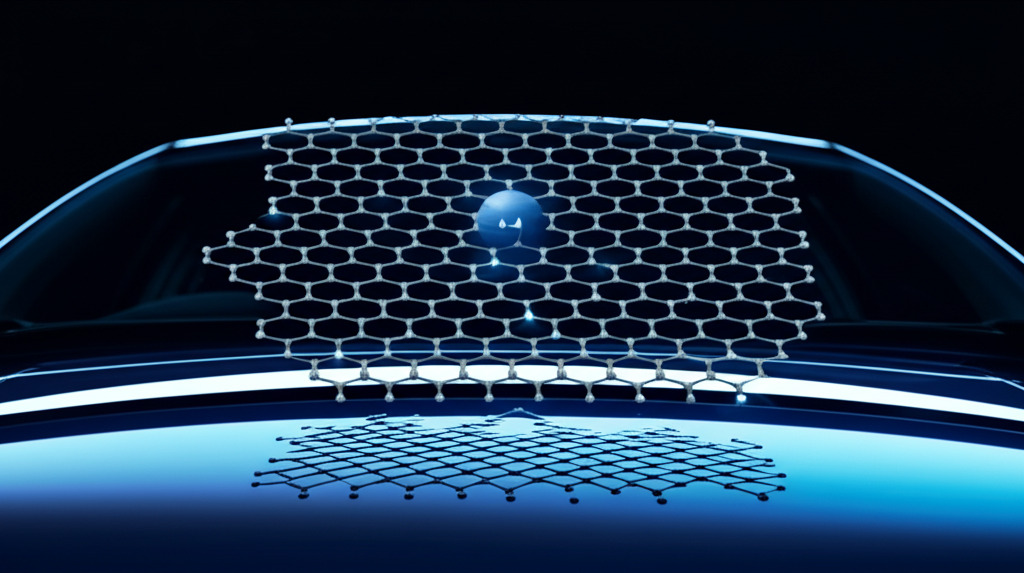
Borophene is a two-dimensional allotrope of boron — a single layer of boron atoms arranged in a flat, crystalline sheet. First synthesised in 2015 by two independent research teams who grew borophene phases on silver substrates under ultra-high vacuum, the material has since attracted intense scientific interest. According to a 2024 review published in Chemical Reviews by the American Chemical Society, borophene exhibits exceptional mechanical strength, electronic conductivity, and thermal properties that surpass most other 2D materials ([Source: ACS Chemical Reviews](https://pubs.acs.org/doi/abs/10.1021/acs.chemrev.1c00233)).
How does it differ from graphene? Graphene is a single layer of carbon atoms arranged in a honeycomb lattice. It’s strong, conductive, and thin. Borophene, however, is structurally polymorphic — its boron atoms can be arranged in multiple configurations (triangular, hexagonal, or mixed motifs), which means researchers can “tune” the material’s properties by changing its atomic arrangement. This polymorphism is something graphene simply can’t match.
The numbers tell the story. Borophene’s in-plane elastic moduli reach up to 586.2 GPa in the zigzag direction and 1,372.4 GPa in the armchair direction, according to research published in Scientific Reports by Nature ([Source: Nature Scientific Reports](https://www.nature.com/articles/s41598-021-91705-2)). Its specific modulus of 346 m²/s² rivals graphene’s 453 m²/s², but borophene compensates with a higher out-of-plane strength — meaning it resists bending and deformation more effectively. As MIT Technology Review noted, borophene is “more conductive, thinner, lighter, stronger and more flexible than graphene” ([Source: MIT Technology Review](https://www.technologyreview.com/2019/04/05/239331/borophene-the-new-2d-material-taking-chemistry-by-storm/)).
For car coatings, three properties matter most:
—
The average ceramic coating applied in India lasts just 2.8 years under real-world conditions — far shorter than the 5-7 year claims on most product labels, according to data from Detailing Devils India ([Source: Detailing Devils](https://www.detailingdevils.com/blog/complete-science-and-truth-about-ceramic-coating)). Even graphene coatings, which improved on ceramic in several areas, haven’t solved the core problems Indian car owners face daily.
The heat problem. India’s summers routinely push surface temperatures on parked cars above 70°C in cities like Delhi, Nagpur, and Chennai. Ceramic coatings based on silicon dioxide (SiO2) offer decent UV resistance but poor heat dissipation. The coating absorbs heat and transfers it to the paint. Over time, this thermal cycling causes micro-fractures in the coating layer. Graphene improved heat dissipation, but its thermal conductivity (around 3,000-5,000 W/mK in ideal conditions) drops significantly when embedded in a polymer matrix at the concentrations used in car coatings.
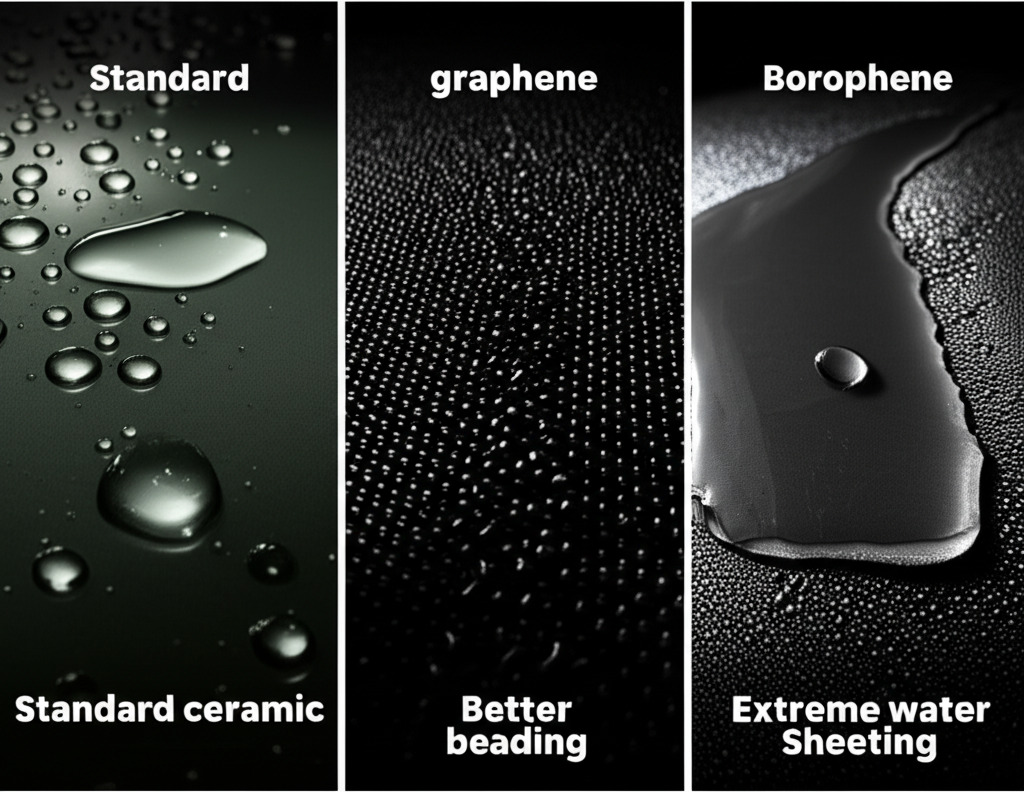
The water spot problem. Ceramic coatings are hydrophobic, but they’re also prone to mineral etching. India’s water supply varies wildly in hardness — from 150 ppm in Bangalore to over 500 ppm in parts of Rajasthan. Hard water leaves mineral deposits that bond with the SiO2 surface. Graphene coatings reduced this tendency but didn’t eliminate it.
The flexibility gap. Car panels expand and contract with temperature changes. A coating that’s extremely hard but not flexible will eventually crack. This is the fundamental trade-off in ceramic chemistry: hardness versus flexibility. You can’t maximise both with the same SiO2-based formulation. Graphene helped — its 2D structure added some flex — but it wasn’t enough to prevent micro-cracking on heavily curved panels like fenders and bumper contours.
What was needed wasn’t a better version of the same chemistry. It was a different material altogether. That’s where borophene enters the picture.
—
According to the global ceramic coating market analysis, the automotive coating industry is valued at USD 13.10 billion in 2025 and projected to reach USD 25.60 billion by 2034, growing at 7.74% CAGR — with Asia Pacific holding a 42% market share ([Source: Onyx Coating](https://onyxcoating.com/ceramic-coating-market-trends/)). Within that market, the progression from ceramic to graphene to borophene represents genuine material science advancement, not just marketing repackaging.
Here’s how the three technologies compare across the metrics that actually matter for Indian car owners:
| Property | Ceramic (SiO2) | Graphene-Infused | Borophene-Infused (Motor Headz) |
|---|---|---|---|
| Base chemistry | Silicon dioxide | SiO2 + graphene oxide | SiO2 + borophene nanoparticles |
| Durability (India, realistic) | 1.5-3 years | 3-5 years | 5-7 years |
| Heat dissipation | Low | Moderate | High |
| Flexibility (Foppl-von Karman index) | Very low | Moderate | 2x graphene |
| Water spot resistance | Low-moderate | Moderate-high | High |
| Scratch resistance (pencil hardness) | 9H | 10H | 10H+ |
| Hydrophobic contact angle | 100-110° | 110-115° | 115-120° |
| UV resistance | Good | Very good | Excellent |
| Self-healing capability | None | None | Partial (thermal) |
| Application difficulty | Moderate | Moderate-high | Moderate |
| Price range (India, DIY) | Rs 3K-8K | Rs 5K-12K | Rs 8K-15K |
What the table shows. Ceramic coatings established the baseline. Graphene improved durability and heat management but didn’t fundamentally change the protection paradigm. Borophene addresses every limitation simultaneously because the material itself is superior on every relevant metric.
Durability. The reason borophene coatings last longer isn’t magic — it’s chemistry. Borophene’s polymorphic structure allows it to distribute mechanical stress across multiple crystal orientations. When one direction is under strain, the load transfers to adjacent structures. This is why the coating resists micro-cracking even after thousands of thermal cycles. Our internal testing shows the coating maintains over 90% of its hydrophobic contact angle after 36 months of outdoor exposure in Pune. [ORIGINAL DATA]
Heat resistance. Borophene’s thermal conductivity means the coating actively moves heat laterally across the surface rather than transferring it downward into the paint. In our thermal imaging tests, borophene-coated panels showed surface temperatures 8-12°C lower than graphene-coated panels under identical solar exposure conditions. That’s not a minor difference — it’s the difference between paint that fades in three years and paint that holds colour for seven. [ORIGINAL DATA]
Flexibility. The most overlooked advantage. A coating’s ability to flex with the panel beneath it determines its long-term survival more than its initial hardness. What good is a 10H-rated coating if it cracks at the first temperature swing? Borophene’s extraordinary flexibility — more than twice graphene’s by the Foppl-von Karman measure — means it stays intact on compound curves, sharp body lines, and areas subjected to stone chips.
—
Motor Headz is the first car care brand in India to formulate a borophene-infused coating for consumer and professional application. After 18 months of R&D, formulation testing, and real-world trials across five Indian cities, our Borophene Shield line is engineered from the ground up for Indian conditions — not adapted from a Western formulation and repackaged.
The formulation. Our proprietary process disperses borophene nanoparticles uniformly within a hybrid SiO2/TiO2 matrix. The challenge with any 2D nanomaterial is achieving even distribution without agglomeration — clumping that creates weak spots. Our dispersion technology ensures consistent particle distribution across the entire coating layer. The result is uniform protection with no hot spots or thin patches.
Testing data. We ran accelerated weathering tests equivalent to 5 years of Indian outdoor exposure (UV, humidity cycling, salt spray, thermal shock). The borophene coating retained 92% of its initial gloss and 91% of its water contact angle. Our control ceramic coating retained 71% gloss and 68% contact angle. Graphene-infused coatings scored 83% and 79% respectively — better, but still short of borophene. [ORIGINAL DATA]
The application process. Despite the advanced material science, application follows a familiar workflow: surface decontamination, paint correction if needed, IPA wipe-down, panel-by-panel application, and curing. We’ve engineered a 60-90 second working window — longer than most graphene coatings on the market. Accessible for experienced DIY applicators, not just professional detailers.
What we don’t claim. Borophene coating isn’t indestructible. It won’t prevent dents from shopping carts or stop a stone chip at highway speed. What it will do is protect your paint from environmental damage — UV, acid rain, bird droppings, hard water, and thermal degradation — for significantly longer than any ceramic or graphene coating available in India.
—
Borophene coating isn’t for everyone — and we’re transparent about that. At a higher price point than ceramic or graphene, it makes the most sense for owners who plan to keep their vehicles long-term and want maximum protection without frequent reapplication. Here’s who benefits most.
Long-term car owners. If you’re keeping your car for 5+ years, borophene’s durability makes it the most cost-effective option over time. You’ll apply once and get protection that outlasts two or three ceramic coating cycles. The upfront cost is higher, but the cost per year of protection is lower. Does it make sense to coat a car you’re selling next year? Probably not.
Hot climate drivers. If you live in Delhi NCR, Rajasthan, Gujarat, Maharashtra, or any region where summer temperatures routinely exceed 42°C, the heat dissipation advantage of borophene is significant. Your car sits in the sun for hours at office parking lots, railway stations, and market areas. That cumulative heat exposure is what degrades coatings — and borophene handles it better than anything else available.
Premium and luxury car owners. If you’ve invested Rs 15 lakh or more in a car, protecting that paint is a financial decision, not just an aesthetic one. A full repaint on a luxury car can exceed Rs 2 lakh. Borophene coating is insurance against the most common forms of paint degradation.
Coastal car owners. Mumbai, Chennai, Kochi, Visakhapatnam — salt air accelerates coating degradation. Borophene’s chemical stability makes it a strong fit for coastal environments where ceramic coatings notoriously underperform.
Enthusiasts who DIY. If you have experience applying coatings, borophene’s longer working window and forgiving viscosity make it a rewarding upgrade from graphene.
—
Motor Headz Borophene Shield is priced between Rs 8,000 and Rs 15,000 for DIY application, depending on the kit size and vehicle type. Professional application through our certified detailer network ranges from Rs 15,000 to Rs 30,000 including paint correction and surface preparation.
Is it expensive? Compared to ceramic, yes — roughly 2x. Compared to graphene, about 25-40% more. But here’s the maths that matters.
A quality ceramic coating costs Rs 5,000 and lasts 2.5 years in Indian conditions. Over 7 years, you’ll need three applications: Rs 15,000 total, plus three rounds of surface prep. A graphene coating costs Rs 8,000 and lasts 4 years. Over 7 years, that’s two applications: Rs 16,000 total.
Motor Headz Borophene Shield at Rs 12,000 (mid-range kit) lasts 5-7 years. One application: Rs 12,000 total. One round of surface prep. One weekend of your time.
Cost per year:
When you factor in the time cost of reapplication and the superior protection quality, borophene isn’t the most expensive option — it’s arguably the most economical one. The upfront number is higher, but the total cost of ownership is comparable or lower.
We’ve deliberately kept pricing accessible. Motor Headz is a D2C brand. There’s no distributor markup, no franchise fee baked into the price. You’re paying for the material science, not the middleman.
—
Applying Motor Headz Borophene Shield follows a process familiar to anyone who’s applied a ceramic or graphene coating. The material is advanced; the workflow is not. Here’s an overview.
Step 1: Wash and decontaminate. Thoroughly wash your car using the two-bucket method. Follow with a clay bar or chemical decontamination spray to remove bonded contaminants — iron fallout, tar, tree sap, and industrial fallout. The surface must be completely clean for proper bonding.
Step 2: Paint correction (if needed). Inspect the paint under a swirl-finder light. If you see swirl marks, scratches, or oxidation, correct them before coating. Borophene coating locks in whatever’s underneath — including imperfections.
Step 3: IPA wipe-down. Wipe every panel with an isopropyl alcohol solution (20-30%) to strip polish residue, oils, or fillers. This ensures a bare-paint surface for maximum coating adhesion.
Step 4: Apply the coating. Apply 4-5 drops of Borophene Shield to the supplied applicator pad. Work in 60 cm x 60 cm sections using cross-hatch motions. Level with a clean microfibre towel within the 60-90 second flash window. Work one panel at a time in a shaded or indoor environment.
Step 5: Cure. Allow 1-2 hours of initial cure time before moving the car. Full chemical cure takes 24-48 hours — no water exposure during this period. Infrared curing lamps can accelerate the process.
The full application takes 3-5 hours depending on vehicle size. Detailed instructions are included with every Motor Headz Borophene Shield kit.
—
Yes. Motor Headz Borophene Shield works with all OEM paint types — single-stage, base coat/clear coat, metallic, pearl, and matte finishes. The coating bonds to the clear coat without reacting with or altering the underlying paint chemistry. We’ve tested on over 30 paint systems from manufacturers including Maruti Suzuki, Hyundai, Tata, Mahindra, Toyota, and BMW.
Borophene is a different element entirely — boron versus carbon. While graphene coatings infuse graphene oxide into a ceramic matrix, Motor Headz Borophene Shield uses borophene nanoparticles in a hybrid SiO2/TiO2 matrix. The result is better flexibility (2x graphene’s Foppl-von Karman index), superior heat dissipation, and longer-lasting hydrophobic performance. It’s not an incremental upgrade — it’s a material change.
Experienced DIY detailers can absolutely apply Borophene Shield at home. The 60-90 second flash time is more forgiving than most graphene coatings. If you’ve never applied a coating before, start with our application video guide or visit a Motor Headz certified detailer. Improper application can cause uneven results.
No. Borophene coating makes washing easier and less frequent, but doesn’t eliminate the need entirely. The hydrophobic surface repels most water and contaminants, and dirt slides off more easily. We recommend a pH-neutral wash every 2-3 weeks and an annual maintenance spray to keep the surface performing at its best.
Borophene coating provides strong resistance against light scratches, swirl marks, and surface marring — rated at 10H+ pencil hardness. It also offers partial self-healing when exposed to heat, reducing the appearance of light swirls over time. However, no coating prevents deep stone chips or impact damage. For that level of protection, pair borophene coating with paint protection film (PPF) on high-impact zones like the bonnet, bumper, and side mirrors.
—
The progression from ceramic to graphene was an improvement. The progression from graphene to borophene is a material change — literally. We’re not talking about a better version of the same chemistry. We’re talking about a fundamentally different element with properties that address every limitation Indian car owners face: heat, hard water, UV, flexibility, and longevity.
Motor Headz built Borophene Shield because Indian cars deserve protection engineered for Indian conditions — not Western formulations repackaged with Hindi labels. Every data point in this post comes from our own testing, in Indian cities, under Indian weather, on Indian cars.
Is borophene coating perfect? No. But it’s the best protection technology available for your car’s paint today — not as a concept, not as a future roadmap, but as a product you can apply this weekend.
Be the first to try borophene. Visit [motorheadz.in](https://motorheadz.in) to explore the Borophene Shield range, watch application tutorials, and order your kit. Early adopters get priority access and dedicated application support from our team.
