Shop by Category:

Uncategorized
Rubbing Polish vs Polishing Compound: What’s the Difference?

April 7, 2026
Share:
Shop by Category:


🚚 Free Ship ₹999+ | SHINE10 = 10% Off
✅ Premium Car Care • 💳 COD Available • 🔄 Easy Returns • 📞 24/7 Support
🚚 Free Ship ₹999+ | SHINE10 = 10% Off
✅ Premium Car Care • 💳 COD Available • 🔄 Easy Returns • 📞 24/7 Support
Car rubbing polish vs polishing compound explained with clear coat facts, defect types, and when each one makes sense for Indian car owners.
India recorded 4.3 million passenger vehicle sales in FY 2024-25, the highest ever, according to SIAM. That means more owners are now trying to preserve paint, gloss, and resale value instead of waiting for the finish to look tired. If you’ve been shopping for car care products, you’ve probably seen two confusing labels again and again: rubbing polish and polishing compound.
The problem? They sound similar, but they do different jobs.
Use the wrong one, and you can waste time, money, and clear coat. Use the right one, and you can fix light defects, improve shine, and prepare paint properly for wax, sealant, or ceramic coating.
TL;DR: Rubbing polish is usually the milder option for refining gloss and removing lighter defects, while polishing compound is more aggressive and better for deeper swirls, oxidation, and sanding marks. Since clear coat is often only 30–50 microns thick and polishing can remove 2–5 microns in one session, product choice matters more than most beginners think (Dr. Beasley’s, 2024).
[Internal link: complete guide to car detailing → pillar post explaining car detailing meaning, process, and stages]
Factory paint systems generally sit in the 100–180 micron range overall, according to DeFelsko, and the clear coat is only one part of that stack (DeFelsko, 2025). The direct answer is simple: polishing compound cuts faster and deeper, while rubbing polish refines more gently and leaves a better finish on lightly damaged paint.
A polishing compound uses stronger abrasives. It is designed to level defects faster. Think moderate swirl marks, oxidation, etching, or sanding marks after paint work. A rubbing polish, on the other hand, is usually used when the defect level is lower or when the paint already looks decent but needs extra clarity and gloss.
In real-world detailing, the difference comes down to cut versus finish. Compounds focus on correction first. Polishes focus on refinement first. Some modern “one-step” products blur the line, but the old rule still works beautifully: if the paint is rougher and more damaged, start with the more corrective product. If the paint is only mildly dull, reach for the gentler option.
According to DeFelsko’s automotive detailing guidance, paint measurement matters because polishing removes material from the top layer and should be done with control, not guesswork (DeFelsko, 2025). That’s why professionals don’t choose a product by label alone. They choose it by defect severity, paint hardness, and the finish expected afterward.
At Motor Headz, the cleaner way to explain this to Indian car owners is this: compound is correction, polish is refinement. If your car lives outside, sees hard water, dusty roads, and regular wiping with dry cloths, you usually need correction before you chase shine.
Quick comparison:
[Internal link: paint correction for cars → deeper guide on defect removal stages and when machine polishing is required]
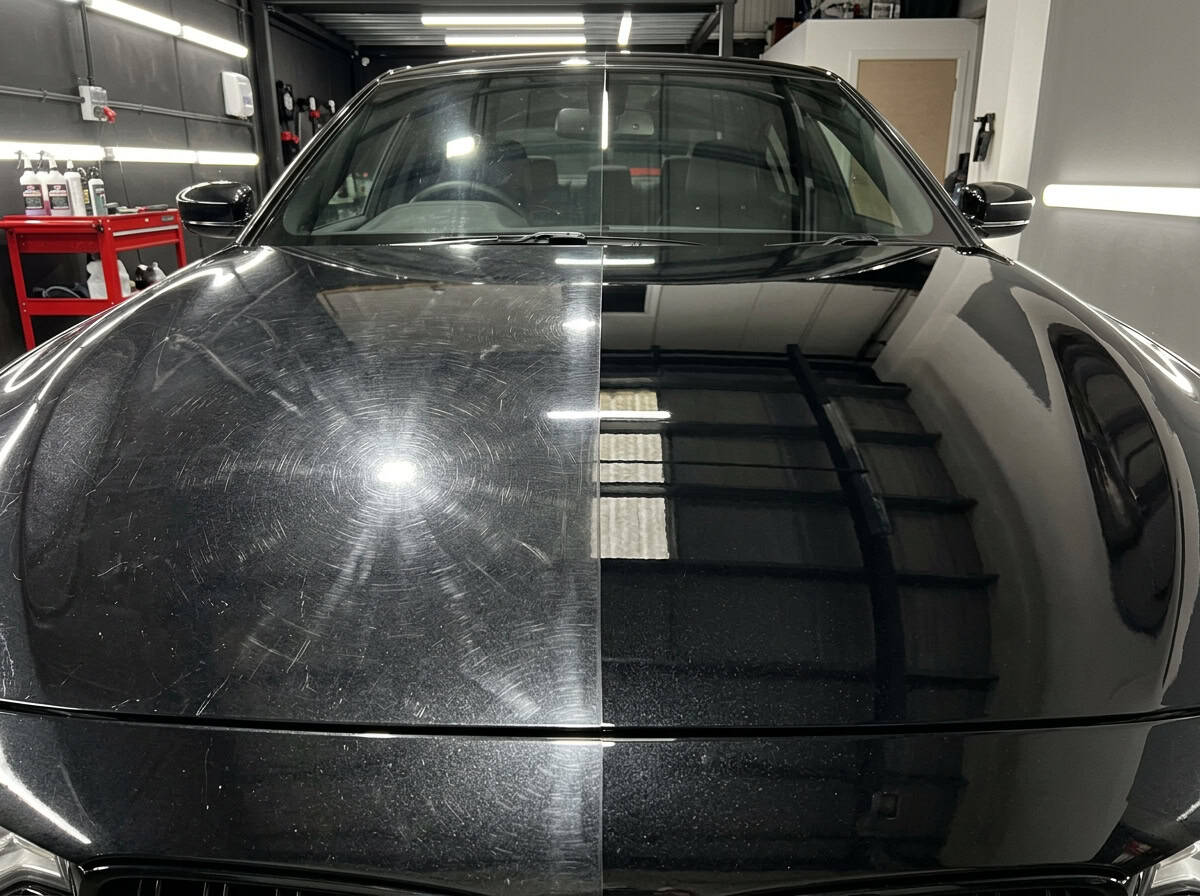
Polishing removes 2–5 microns of clear coat in a session, while many factory clear coats are only 30–50 microns thick, according to Dr. Beasley’s paint care guidance (Dr. Beasley’s, 2024). That means you should use a polishing compound only when the defect is serious enough to justify that extra cut.
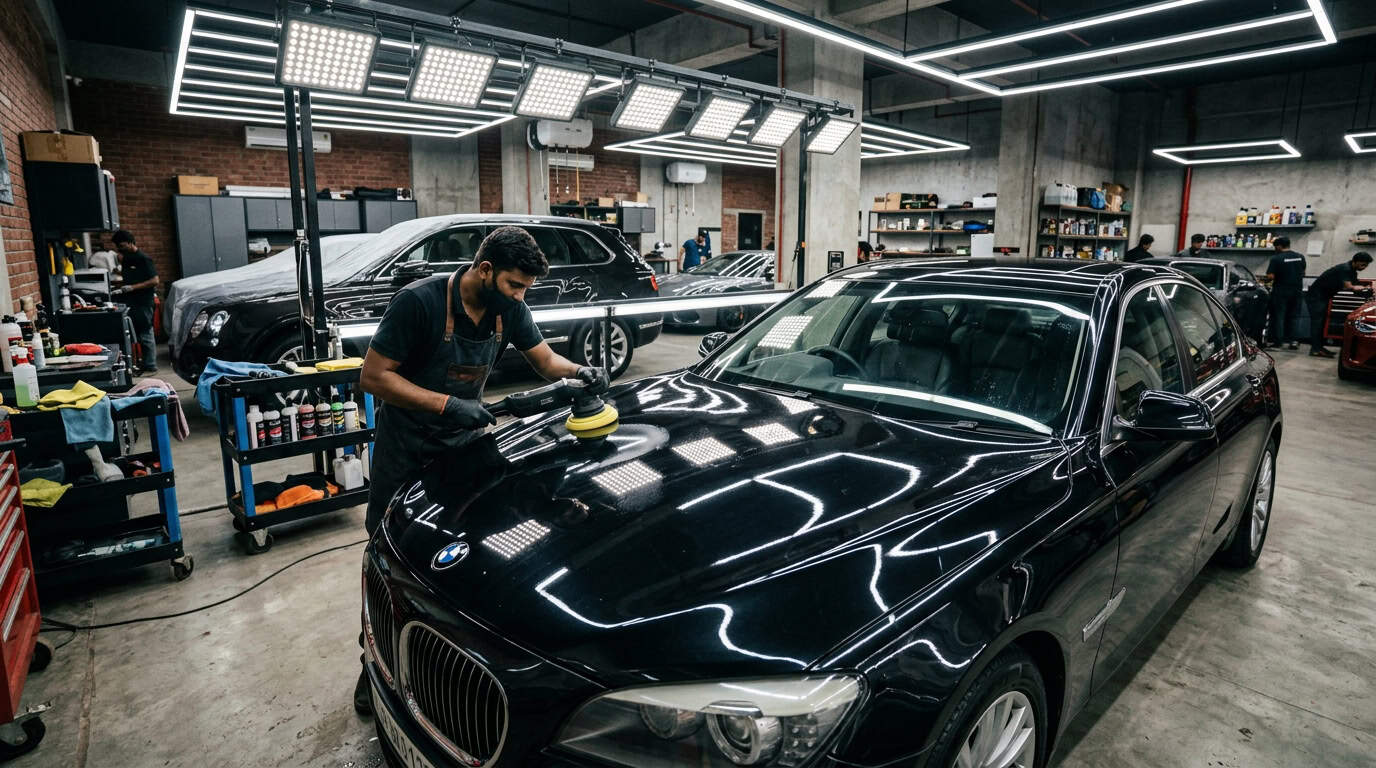
Use a polishing compound when your paint has visible swirl marks under sunlight, heavier oxidation, old water-spot etching, light scratches that do not catch a fingernail deeply, or sanding haze after touch-up work. Compounds are also helpful when a neglected car has lost depth and clarity across the whole panel.
But let’s be clear: not every dull panel needs compound. That’s where beginners go wrong. They assume stronger is better. It isn’t. Stronger is only better when the paint truly needs stronger correction.
A good rule is to inspect the car in harsh light first. If the marks are shallow and mostly visible only from angles, a rubbing polish may be enough. If the defects are obvious even in normal daylight, compounding may be justified.
According to DeFelsko, manufacturers recommend careful removal limits because over-cutting the top layer can compromise UV protection (DeFelsko, 2025). That’s why detailers test a small section before attacking the whole car.
Use compound if you see:
Avoid starting with compound if:
According to Dr. Beasley’s, polishing should be done as little as possible because every corrective step removes some clear coat (Dr. Beasley’s, 2024). That’s a useful mindset for beginners. Fix what needs fixing. Don’t chase perfection on daily drivers.
[Internal link: how to remove car scratches at home → guide covering scratch depth checks and safe DIY correction limits]
Modern vehicle demand is still strong in India, with passenger vehicles hitting 4.3 million units in FY 2024-25, according to SIAM (SIAM, 2025). For many of those cars, especially newer ones, the paint defects are not severe enough to need aggressive compounding. In those cases, rubbing polish is the smarter, safer first move.
Rubbing polish works best for light swirls, mild haze, loss of gloss, and post-compound refinement. It can also be used as a maintenance correction step for cars that already receive careful washing and paint protection. If a car looks dull but does not show deep scratches, polish is often enough to wake the finish back up.
This matters because beginners often jump straight to heavier abrasives without trying a test spot. The safer workflow is always to start with the least aggressive option that can still deliver the result.
In Indian conditions, we often see cars that are not heavily scratched but are visibly greyed out by dust wiping, hard water marks, and cheap roadside washes. On these cars, a good polish paired with the right foam or microfiber pad often restores more shine than people expect. You don’t always need to go nuclear.
A polish is also ideal after compounding because compounds can leave micro-marring or haze, especially on softer paint. The polish then restores clarity, gloss, and that deeper reflective finish owners actually notice.
A quotable way to think about it is this: when the goal is beauty more than rescue, polish usually beats compound. Since paint correction removes measurable film build and clear coat protection is limited, the least aggressive successful step is almost always the best one for long-term paint health (DeFelsko, 2025).
Choose rubbing polish for:
[Internal link: ceramic coating benefits → post-correction protection article explaining why corrected paint should be sealed quickly]
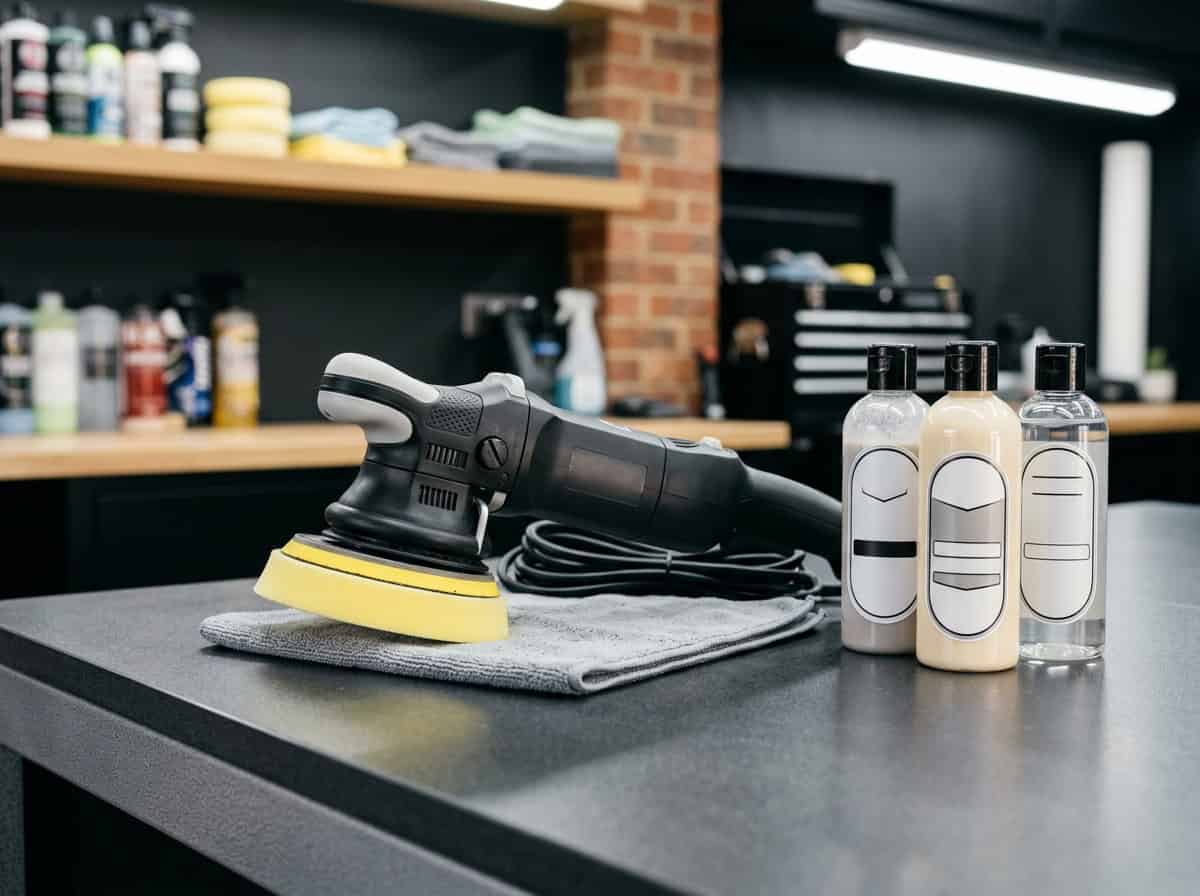
Automotive paint correction works within thin tolerances, and total factory paint is commonly cited in the 100–180 micron range (DeFelsko, 2025). So yes, rubbing polish is generally safer for beginners than polishing compound, because it removes defects more slowly and gives you more margin for error.
That doesn’t mean polish is foolproof. You can still create haze, overwork an edge, or run a dirty pad across a panel. But compared with a stronger compound, the risk is lower. For someone learning machine speed, arm movement, pad pressure, and section passes, that matters.
The biggest beginner mistake isn’t using the wrong brand. It’s using too much aggression before learning process control. A decent polish on the right pad can teach you more than an aggressive compound ever will.
If you’re just starting out, don’t ask, “What’s the strongest product I can buy?” Ask, “What’s the weakest product that still gets me to 80–90% improvement?” That question saves clear coat, money, and regret.
Here’s a beginner-safe order of operations:
1. Wash and decontaminate the car properly. 2. Inspect under direct light. 3. Do one small test spot. 4. Start with polish and a softer pad. 5. Increase aggression only if the result is poor. 6. Refine the finish before applying protection.
According to Dr. Beasley’s, polishing should be used sparingly because each session removes some clear coat that the vehicle cannot naturally replace (Dr. Beasley’s, 2024). For beginners, that’s the whole game: respect the material.
[Internal link: best car rubbing machine for beginners in India → buying guide on machine types, pad control, and beginner-safe setups]
Clear coat condition, not label hype, decides final gloss. Since polishing can remove 2–5 microns and clear coat itself may be only 30–50 microns thick, the best-shining product is the one that leaves the surface both level and refined (Dr. Beasley’s, 2024). In most cases, rubbing polish gives the better final shine, while compound gives the bigger correction jump.
A compound can dramatically improve a neglected panel by removing more visible defects. That can make the car look much better instantly. But if you compare final finish quality on an already-corrected panel, polish usually wins because it creates better clarity, depth, and reflectivity.
That’s why professional workflows often use both. First, a compound handles the heavy lifting. Then, a polish finishes the paint. The result is not just fewer defects. It’s a cleaner reflection.
On harder paints, some modern compounds finish surprisingly well. On softer paints, even a good compound can leave light haze. So the answer depends on paint type, pad choice, machine action, and operator technique.
A concise way to put it: compound reveals the shine by removing defects; polish perfects the shine by refining the surface. If your paint is already in decent condition, jumping straight to polish often gives the most satisfying gloss-per-risk ratio.
[Internal link: graphene coating vs ceramic coating → comparison post on how paint finish affects coating performance and appearance]
Indian roads, dust, UV exposure, hard water, and wipe-based cleaning habits create a broad range of paint conditions, even on newer cars. With India’s passenger vehicle market at a record 4.3 million units in FY 2024-25, according to SIAM, choosing the right correction step is becoming a mainstream ownership decision, not a niche enthusiast one (SIAM, 2025). The best choice is based on defect depth, paint thickness, skill level, and the result you want.
Use this practical filter:
According to DeFelsko, paint-thickness measurement is not just for body shops; it directly improves detailing decision-making because it helps balance correction with preservation (DeFelsko, 2025). That’s the smartest takeaway here. Car care is not about being aggressive. It’s about being precise.
Rubbing polish can remove or reduce light scratches and wash swirls, but it usually won’t fix deeper scratches that cut too far into the clear coat. Since polishing removes only a thin amount of material and many clear coats are just 30–50 microns thick, deep defects often need compounding or even paint repair (Dr. Beasley’s, 2024).
[Internal link: types of car scratches → article explaining clear-coat, primer, and deep paint damage]
Polishing compound is not bad when used correctly, but it is more aggressive than polish and removes more material while correcting defects. DeFelsko notes that factory paint systems often range 100–180 microns total, so unnecessary heavy correction can reduce safety margin for future polishing (DeFelsko, 2025).
[Internal link: paint correction for cars → full guide on safe correction limits and process]
Use whichever step gets the paint defect-free with the least aggression possible. For light defects, polish may be enough. For moderate defects, compound first and polish after. Because coatings lock in the finish underneath, the prep step matters more than the label, especially when polishing can remove 2–5 microns per session (Dr. Beasley’s, 2024).
[Internal link: ceramic coating benefits → guide on why prep quality affects coating performance]
Yes, but beginners should test carefully and start with the least aggressive pad and product combination possible. A dual-action machine is safer than a rotary for new users, yet the risk still rises when using stronger abrasives. Since correction happens within a thin paint system of around 100–180 microns, process control matters more than speed (DeFelsko, 2025).
[Internal link: best car rubbing machine for beginners in India → machine guide for DA vs rotary choices]
As little as necessary. Dr. Beasley’s says polishing removes 2–5 microns at a time, while clear coat is often just 30–50 microns thick, so frequent correction is not a smart habit (Dr. Beasley’s, 2024). Wash safely, protect the paint, and reserve polishing for when gloss loss or defects actually justify it.
[Internal link: how to wash your car at home like a pro → future post on maintenance washing that reduces polishing frequency]
<script type="application/ld+json">
{
  "@context": "https://schema.org",
  "@type": "FAQPage",
  "mainEntity": [
    {
      "@type": "Question",
      "name": "Can rubbing polish remove scratches from a car?",
      "acceptedAnswer": {
        "@type": "Answer",
        "text": "Rubbing polish can reduce light scratches and wash swirls, but it usually cannot fix deeper scratches. Polishing removes only a thin amount of material, and clear coat is often just 30-50 microns thick, according to Dr. Beasley’s 2024 guidance."
      }
    },
    {
      "@type": "Question",
      "name": "Is polishing compound bad for car paint?",
      "acceptedAnswer": {
        "@type": "Answer",
        "text": "Polishing compound is not bad when used correctly, but it is more aggressive than polish and removes more material. DeFelsko notes factory paint systems often range from 100-180 microns total, so unnecessary heavy correction reduces long-term safety margin."
      }
    },
    {
      "@type": "Question",
      "name": "Should I use polish or compound before ceramic coating?",
      "acceptedAnswer": {
        "@type": "Answer",
        "text": "Use the least aggressive step that achieves the correction you need. Light defects may only need polish, while moderate defects may need compound followed by polish, especially because polishing can remove 2-5 microns in a session."
      }
    },
    {
      "@type": "Question",
      "name": "Can beginners use a polishing compound with a dual-action machine?",
      "acceptedAnswer": {
        "@type": "Answer",
        "text": "Yes, but beginners should test carefully, start with a mild pad-product combination, and work within a thin paint system. DeFelsko notes factory paint systems commonly range 100-180 microns total, so controlled correction is essential."
      }
    },
    {
      "@type": "Question",
      "name": "How often should I polish my car?",
      "acceptedAnswer": {
        "@type": "Answer",
        "text": "As little as necessary. Dr. Beasley’s says polishing removes 2-5 microns while clear coat is often only 30-50 microns thick, so frequent correction is not ideal. Safer washing and protection reduce the need to polish often."
      }
    }
  ]
}
</script>
