What is Graphene Ceramic Coating? Graphene vs Ceramic Explained
India sold 4.3 million passenger vehicles in FY 2024-25. Learn what graphene ceramic coating is, how it compares with ceramic, and what really matters in India.
# What is Graphene Ceramic Coating? Graphene vs Ceramic Explained
India recorded **4.3 million passenger vehicle sales in FY 2024-25**, the highest ever, according to SIAM ([SIAM](https://www.siam.in/pressrelease-details.aspx?mpgid=48&pgidtrail=50&pid=579), 2025). That matters because more owners are now entering the coating market and hearing new buzzwords every month. Ceramic coating used to be the shiny new thing. Now the newer, cooler, more expensive phrase is often **graphene ceramic coating**.
And yes, it sounds futuristic enough to justify a bigger invoice.
But what is it really? Is it a coating made entirely from graphene? Is it dramatically better than ceramic? Or is it, at least in some cases, a ceramic coating with graphene additives and a stronger sales story?
The short answer is that **graphene ceramic coating is usually a ceramic-style coating formula that includes graphene-related ingredients or branding to improve certain properties such as slickness, anti-static behavior, or heat-related claims**. The long answer is where the real buying decision lives.
> **TL;DR:** Graphene ceramic coating is usually **not** a totally separate category from ceramic coating. In most cases, it is a ceramic-style coating enhanced or marketed with graphene-related ingredients. With India’s detailing market at **USD 3,633.4 million in 2024** and rising at **6.4% CAGR** ([Grand View Research](https://www.grandviewresearch.com/horizon/outlook/car-detailing-services-market/india), 2025), buyers should compare prep quality, installer skill, durability claims, and maintenance support before paying extra for graphene hype.
[INTERNAL-LINK: what is crystal coating for cars → article on how coating labels can confuse buyers]
## What is graphene ceramic coating on a car?
The global graphene market is projected to grow from **USD 694.4 million in 2025 to USD 2.3 billion by 2030**, at **27.5% CAGR**, according to BCC Research ([BCC Research](https://www.bccresearch.com/pressroom/avm/graphene-market-to-grow-at-275-cagr), 2025). That kind of growth guarantees one thing: graphene will appear in marketing everywhere. The direct answer is this: **graphene ceramic coating is typically a liquid paint-protection coating based on ceramic-style chemistry, with graphene or graphene-related additives positioned as a performance upgrade.**
That means the coating still belongs largely to the same practical world as ceramic. It bonds to the paint, forms a protective layer, and aims to improve gloss, hydrophobic behavior, contamination release, and ease of washing. The graphene part is meant to tweak the formula rather than replace the entire ceramic concept.
Why do brands push it so hard? Because it gives them a new story to tell. In detailing, new story often equals new premium.
Some manufacturers and detailing educators connect graphene with better slickness, reduced static attraction, and lower surface heat behavior. DriveDetailed, for instance, notes that graphene’s conductivity is often used to support **anti-static** dust-reduction claims ([DriveDetailed](https://drivedetailed.com/graphene-coating-for-cars-why-the-hype/), 2021). That does not mean every graphene coating is automatically superior. It means the formula may be tuned differently.
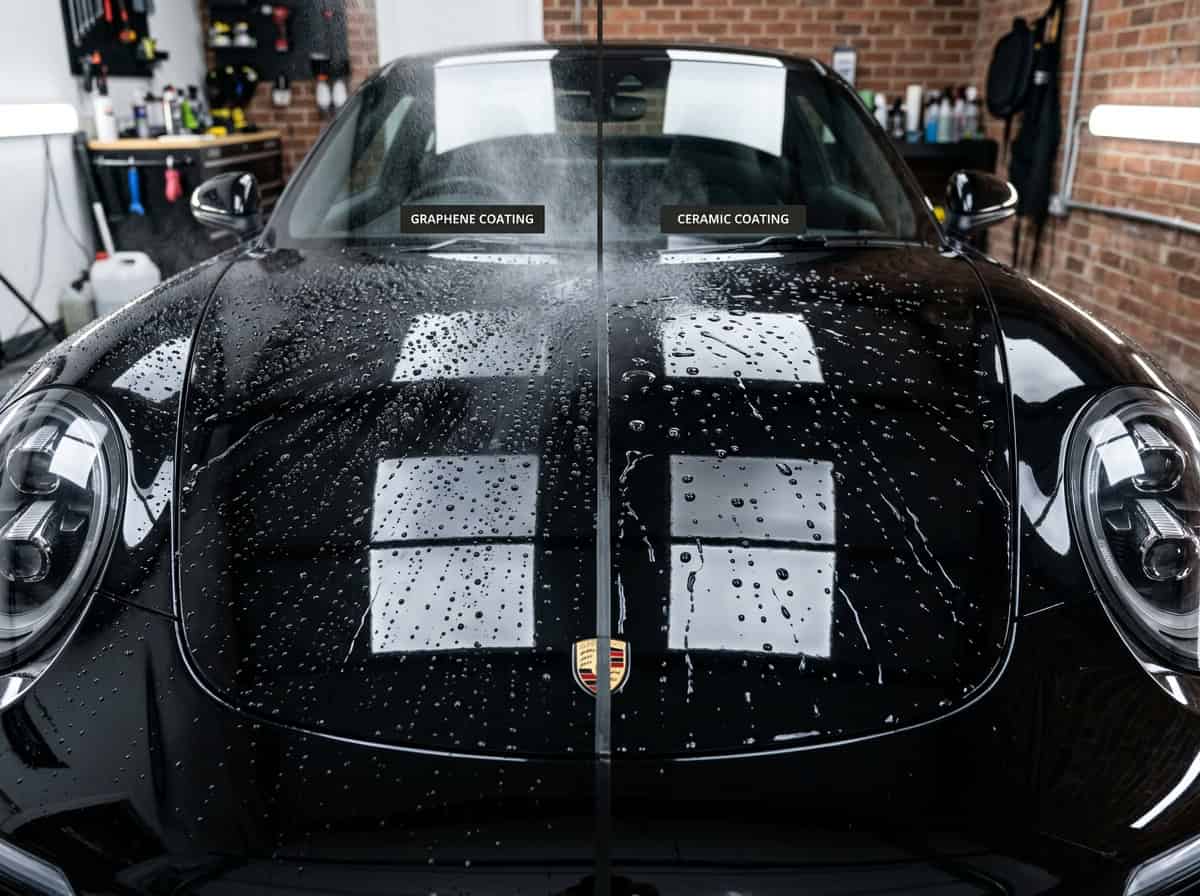
The smartest mental model is this: **graphene coating is usually ceramic coating’s ambitious cousin, not its total replacement**. If the rest of the formula, prep, and application are weak, the graphene label won’t rescue the outcome.
A concise citation-style summary: **In real-world detailing, graphene ceramic coatings are generally ceramic-style protective coatings with added graphene-related technology or branding, designed to promise benefits such as slickness, anti-static behavior, and improved user perception rather than a completely different coating mechanism.**
[INTERNAL-LINK: ceramic coating explained for beginners → base article on how ceramic coatings bond to paint]
Most graphene products are still ceramic-style coatings at heart, with formula tweaks and upgraded positioning.
## Is graphene coating better than ceramic coating?
India’s car detailing services market generated **USD 3,633.4 million in 2024** and is expected to reach **USD 5,261.2 million by 2030**, according to Grand View Research ([Grand View Research](https://www.grandviewresearch.com/horizon/outlook/car-detailing-services-market/india), 2025). As choices expand, owners naturally ask which coating is best. The direct answer is: **graphene coating is not automatically better than ceramic coating; it may be better in certain formulations or conditions, but a well-applied ceramic coating will often outperform a poorly marketed graphene package.**
That distinction matters more than the hype cycle.
A good ceramic coating already delivers what most daily drivers want: gloss, easier washing, water behavior, and some resistance to contaminants. A graphene-enhanced coating may add benefits such as extra slickness or reduced dust attraction. Some brands also claim improved resistance to water spotting due to lower surface heat buildup. Those claims can sound appealing in India, where cars sit in brutal sun and hard water is common.
But the bigger truth is boring and important. Coating performance is usually shaped by:
– paint prep quality
– coating chemistry
– installer skill
– cure conditions
– maintenance quality after delivery
If those five things are wrong, graphene will not save the result.
For Indian owners, the “better” coating is often the one backed by the better studio. You will notice clean prep, careful leveling, honest aftercare advice, and a proper wash routine long before you scientifically verify any graphene marketing claim.
A quotable takeaway: **Graphene can be a meaningful formulation upgrade, but it is not a shortcut around bad prep, weak maintenance, or vague installer promises. In the real world, process quality still beats hype quality.**
[INTERNAL-LINK: how to choose a detailing studio in India → checklist for comparing installers before paying for any coating package]
## What are the real differences between graphene and ceramic in daily use?
Mordor Intelligence estimates the global detailing market at **USD 42.64 billion in 2025**, with Asia Pacific as the fastest-growing region ([Mordor Intelligence](https://www.mordorintelligence.com/industry-reports/car-detailing-services-market), 2025). That means everyday users, not just enthusiasts, are now asking practical questions. The direct answer is this: **in daily use, the differences between graphene and ceramic are often subtle, with graphene packages usually emphasizing slickness, anti-static behavior, and water-spot management, while ceramic remains the better-known durability benchmark.**
Let’s make that human.
If you coat two similar daily drivers and maintain them properly, both can look rich, glossy, and easier to wash. The owner may notice graphene feels slicker to the touch or appears to attract dust a bit less in some conditions. Some installers also say graphene coatings handle hotter panels better during everyday use.
At the same time, ceramic coatings have a much longer mainstream track record. Many installers understand them deeply. Maintenance products are easier to match. Consumer expectations are clearer. That maturity has value.
DriveDetailed notes that graphene’s conductivity is often cited for anti-static claims that may help reduce dust buildup ([DriveDetailed](https://drivedetailed.com/graphene-coating-for-cars-why-the-hype/), 2021). But notice the careful wording there: “may help.” Not magic. Not zero dust. Not a miracle shield against Indian roads.
Here’s the practical daily-use split:
– **Graphene:** marketed for slickness, reduced static, possible dust advantages, trendy premium factor
– **Ceramic:** known benchmark, easier to compare, proven maintenance ecosystem, strong gloss and protection when applied well
If you are the kind of owner who wants the newest option and trusts the installer, graphene may appeal. If you want a familiar, proven category with fewer storytelling variables, ceramic often feels like the calmer buy.
[INTERNAL-LINK: how long ceramic coating lasts in India → durability guide for realistic maintenance planning]
The real difference between graphene and ceramic usually shows up in maintenance feel and installer execution, not just marketing terms.
## Which coating makes more sense for Indian weather and driving?
SIAM’s **4.3 million-unit FY 2024-25** passenger vehicle figure shows just how mainstream vehicle care has become in India ([SIAM](https://www.siam.in/pressrelease-details.aspx?mpgid=48&pgidtrail=50&pid=579), 2025). In this climate, the direct answer is: **for Indian weather, both graphene and ceramic can work well, but the better choice is the product with the clearer support system, stronger maintenance plan, and more credible installer.**
Why? Because India is not a gentle test environment.
Cars face high heat, airborne dust, monsoon grime, inconsistent wash quality, and mineral-heavy water in many cities. Under those conditions, your coating needs to do three jobs well:
1. make washing easier
2. reduce bonded contamination
3. help preserve gloss between proper maintenance washes
A graphene coating may have an edge in brand-specific slickness or anti-static feel. A ceramic coating may win on predictability, availability, and installer familiarity. The gap between them is often smaller than the gap between a good detailer and a careless one.
Dr. Beasley’s notes that clear coat is typically only **30–50 microns** thick and polishing can remove **2–5 microns** ([Dr. Beasley’s](https://www.drbeasleys.com/blog/2024/11/08/how-often-should-i-polish-my-car), 2024). That matters because the real long-term goal is reducing how often your paint needs aggressive correction. Any coating that helps you wash safer and preserve finish longer is already doing meaningful work.
For Indian owners, the best coating question is not “Which one is the most advanced?” It is **“Which one helps me need polishing less often?”** That is a far smarter ownership lens.
[INTERNAL-LINK: ceramic coating benefits for Indian car owners → article focused on everyday ownership value, not just detailing jargon]
## Should you pay extra for graphene ceramic coating?
The global graphene market’s projected **27.5% CAGR** shows how powerful the material’s commercial story has become ([BCC Research](https://www.bccresearch.com/pressroom/avm/graphene-market-to-grow-at-275-cagr), 2025). That makes the pricing question unavoidable. The direct answer is: **pay extra for graphene only if the studio can explain the formula, prep steps, maintenance plan, and measurable value; otherwise a quality ceramic coating is usually the safer spend.**
Think like a buyer, not a fan.
If the graphene package includes stronger paint prep, better aftercare, annual inspections, or a more skilled installer, the premium may be justified. But if the only difference is a shinier brochure and a louder claim, step back.
Ask these questions before paying more:
– Is the added cost coming from chemistry or just branding?
– How many correction stages are included?
– What is the realistic durability in Indian conditions?
– What maintenance products are recommended?
– What happens if water spotting or high spots appear?
A good ceramic coating package often wins because it is easier to understand and compare. That clarity itself has value. Buyers spend too much time chasing “latest” and too little time checking process.
A citation-ready summary: **Graphene ceramic coating can justify a premium when the chemistry, installer skill, and aftercare system are genuinely stronger, but a transparent ceramic package is often the better value when the graphene claim is vague or purely marketing-led.**
[INTERNAL-LINK: questions to ask before booking a coating package → practical buyer checklist]
## Frequently Asked Questions
### Is graphene coating the same as ceramic coating?
Not exactly. In most cases, graphene coating is still a ceramic-style paint-protection product with graphene-related additives or branding. It is usually closer to ceramic than separate from it. The biggest differences are often in formula tuning, product positioning, and how the installer explains the package.
[INTERNAL-LINK: crystal coating vs ceramic coating → comparison of another commonly confused coating label]
### Does graphene coating reduce dust on cars?
Some brands and detailing educators link graphene to **anti-static** behavior that may help reduce dust attraction. DriveDetailed highlights that conductivity is often used to support those anti-static claims ([DriveDetailed](https://drivedetailed.com/graphene-coating-for-cars-why-the-hype/), 2021). That said, it does not mean your car will stay dust-free on Indian roads.
[INTERNAL-LINK: how to maintain a coated car in India → guide to washing and dust management]
### Is graphene coating worth it in India?
It can be, especially if your installer is strong and the package is honest about what you’re getting. But it is not an automatic upgrade over every ceramic coating. India’s detailing market is already **USD 3,633.4 million**, so buyers should expect more marketing noise and compare process quality carefully ([Grand View Research](https://www.grandviewresearch.com/horizon/outlook/car-detailing-services-market/india), 2025).
[INTERNAL-LINK: how to choose a detailing studio in India → installer checklist before spending on premium packages]
### Which lasts longer: graphene or ceramic coating?
That depends more on the specific product, prep quality, and maintenance than the label alone. Some graphene packages may last longer. Some won’t. The safer assumption is that durability comes from formulation and care routine, not from the word “graphene” by itself.
[INTERNAL-LINK: how long ceramic coating lasts in India → realistic durability expectations for daily drivers]
### Can graphene coating prevent scratches?
No coating makes paint scratch-proof. Graphene and ceramic both help with easier cleaning and can reduce minor wash-related damage when maintained properly, but they do not replace safe wash technique. Since clear coat is commonly only **30–50 microns** thick, careless washing can still mark coated paint ([Dr. Beasley’s](https://www.drbeasleys.com/blog/2024/11/08/how-often-should-i-polish-my-car), 2024).
[INTERNAL-LINK: safe washing guide for coated cars → article on avoiding swirl marks after protection]
## FAQ Schema
“`html
“`
## Yoast SEO Fields
Focus Keyphrase: graphene ceramic coating
SEO Title: Graphene Ceramic Coating vs Ceramic – Motor Headz (51 chars)
Slug: what-is-graphene-ceramic-coating-vs-ceramic
Meta Description: Graphene ceramic coating explained for India: what it is, how it compares with ceramic, and whether the extra cost is really worth it. (136 chars)
Cornerstone: false
Schema Page Type: Article
Social Title: Graphene vs Ceramic Coating: Better Protection or Better Marketing?
Social Description: Graphene coating sounds futuristic, but does it actually beat ceramic on Indian roads? Here’s the practical answer on value, durability, dust, and maintenance.
Social Image: use featured image
Secondary Keywords: graphene vs ceramic coating, graphene coating for cars, ceramic coating India, paint protection coating, coated car maintenance
## Conclusion
Graphene ceramic coating is real, but the way it’s sold is often louder than the way it performs.
For most buyers, the clearest truth is this: **graphene is usually an upgraded or differently positioned ceramic-style coating, not an entirely separate universe of protection**. That can still be valuable. It just should not be treated like magic.
**Key takeaways:**
– graphene coatings are usually ceramic-style formulas with added graphene-related positioning
– they may offer slickness or anti-static benefits, depending on formulation
– ceramic remains the easier category to understand and compare
– Indian weather rewards maintenance quality more than buzzwords
– pay extra only when the process, support, and chemistry genuinely justify it
If you want the smartest buy, look past the trend and into the install sheet.
[INTERNAL-LINK: ceramic coating benefits for Indian car owners → next article on what protection actually changes in daily ownership]
Newsletter Updates
Enter your email address below and subscribe to our newsletter