
9H Ceramic Coating Explained: Hardness Ratings Demystified
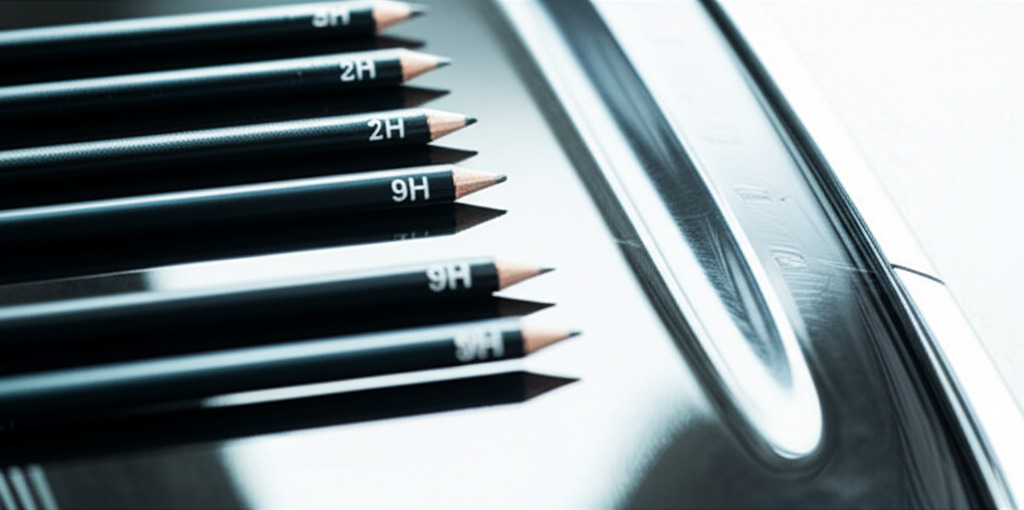
9H hardness sounds impressive — until you realise a regular writing pencil is about 2H. So what does 9H actually mean for your car? If you’ve been shopping for a ceramic coating in India, you’ve probably seen “9H” plastered across every product page and detailing studio banner. It’s become a buzzword that sells coatings faster than facts can keep up. But here’s the uncomfortable truth: most car owners — and even some installers — don’t fully understand what this number represents, where it comes from, or what it can genuinely do for your paint.
This post strips the marketing away. We’ll walk through the real science behind 9H ceramic coating ratings, settle the 9H vs 10H debate once and for all, and show you what actually matters when choosing paint protection. No jargon walls. No sales pitch. Just the facts you need before spending Rs 15,000–50,000 on a coating.
TL;DR: 9H refers to the pencil hardness scale (not the Mohs mineral scale). It means a coating resists scratches from a 9H pencil — the hardest grade on the standard scale. It won’t make your car scratch-proof. Any brand claiming “10H” is making up numbers, since the official ASTM scale stops at 9H. Focus on SiO2 concentration, surface prep, and brand reputation instead.
—
What Does 9H Actually Mean?
According to ASTM International’s [D3363 standard](https://store.astm.org/d3363-22.html), 9H is the maximum rating on the pencil hardness scale used to test coating film hardness — a scale that ranges from 6B (softest) to 9H (hardest). A 9H ceramic coating simply means it wasn’t scratched by a 9H pencil during a standardised lab test. That’s it. No diamond-like armour. No mythical force field.
The Pencil Hardness Scale, Not Mohs
Here’s where the confusion starts. Most people hear “9H” and mentally connect it to the Mohs mineral hardness scale, where diamond sits at 10. On the Mohs scale, a 9H pencil hardness rating translates to roughly a 3 — equivalent to calcite, which you can scratch with a copper coin. That’s a far cry from the sapphire-level toughness that marketing materials imply.
The pencil hardness method, also called the Wolff-Wilborn test, was originally developed by pencil manufacturers as a quality control tool in the early 1900s. Pencils are made with varying ratios of clay to graphite — more clay means a harder pencil. The grading runs: 6B, 5B, 4B, 3B, 2B, B, HB, F, H, 2H, 3H, 4H, 5H, 6H, 7H, 8H, 9H. That’s 17 grades total.
What the Test Actually Measures
The test measures a coating’s resistance to being gouged or marked by pencil leads of increasing hardness. It doesn’t measure impact resistance. It doesn’t measure chemical resistance. It doesn’t tell you how the coating will perform against a shopping cart, a wayward key, or a stone chip on the Mumbai-Pune Expressway.
Citation Capsule: The pencil hardness test evaluates a coating’s resistance to surface marking under controlled lab conditions. Per ASTM D3363, results can vary between labs depending on pencil brand and batch, meaning even the “9H” rating isn’t perfectly consistent across manufacturers. — [ASTM D3363-22 Standard](https://store.astm.org/d3363-22.html); [Micom Labs](https://www.micomlab.com/micom-testing/astm-d3363/)
Why It’s So Misunderstood
The problem is branding. When detailing studios market “9H protection,” they’re borrowing the authority of a standardised test and wrapping it in consumer-friendly language that overpromises. A car owner walks in expecting near-invincibility and walks out with what is, in reality, a very good — but not indestructible — surface film that’s typically just 1–2 microns thick.
—
9H Hardness: What It Can and Can’t Do
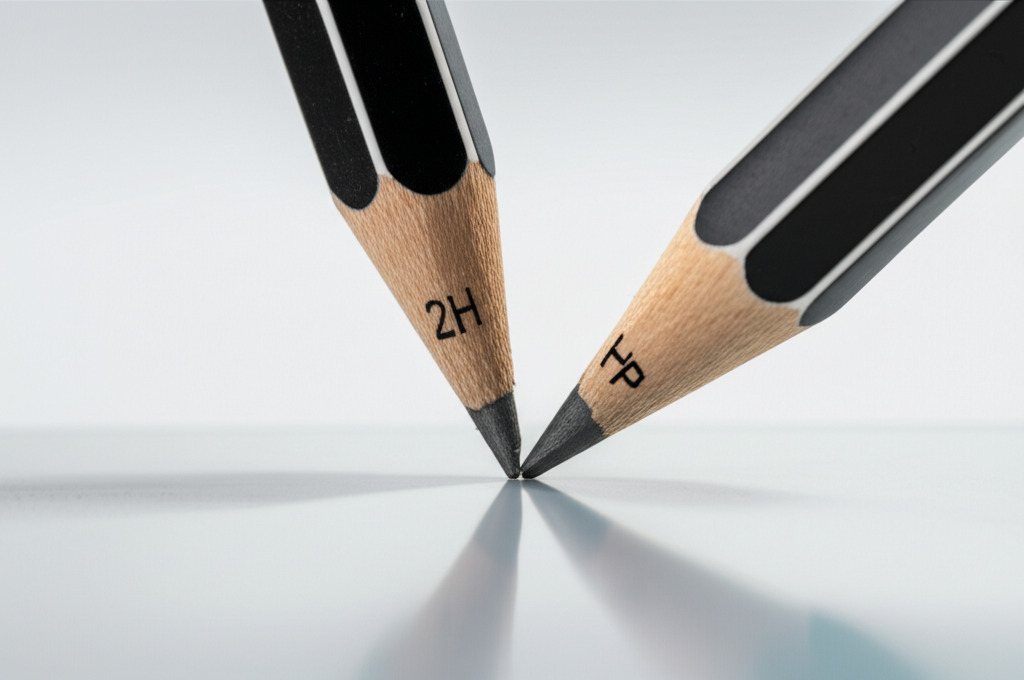
A legitimate 9H ceramic coating does offer measurable scratch resistance — just not the kind most people imagine. According to [IGL Coatings](https://blog.iglcoatings.com/ceramic-coating-hardness/), 9H-rated coatings are tested at a film thickness of 25–38 microns in lab settings, but on your car, the actual coating layer is usually under 5 microns. At that thinness, the substrate underneath becomes a major factor in real-world performance.
What 9H Can Do
A quality 9H coating genuinely helps with light surface scratches, swirl marks from improper washing, minor abrasion from dust and grime, and water spotting resistance. If you’re hand-washing your car properly, a 9H coating will keep those fine cobweb scratches at bay far better than wax or sealant alone.
What 9H Cannot Do
It won’t stop rock chips on the highway. It won’t prevent a key scratch from a malicious neighbour. It won’t protect against shopping cart dings, tree branch scrapes, or the kind of damage that penetrates through clear coat. These require paint protection film (PPF), not ceramic coatings.
Information Gain: Think of it this way — ceramic coatings are a shield against the world’s small annoyances, not its big assaults. They’re sunscreen, not body armour.
The Myth-Bust
Anyone telling you a ceramic coating makes your car “scratch-proof” is either misinformed or misleading you. The correct term is scratch-resistant, and even that comes with conditions. If you drag a rough microfibre towel across a coated panel with enough force, you’ll still leave marks. The coating raises the threshold — it doesn’t eliminate it.
—
9H vs 10H Ceramic Coating: Is There a Real Difference?
Here’s the straightforward answer: the ASTM D3363 pencil hardness scale officially stops at 9H. There is no standardised 10H pencil. Any brand claiming “10H” or “12H” ceramic coating hardness is using a number that doesn’t exist on the recognised testing scale. As [OCD Car Care](https://www.ocdcarcare.com/auto-detailing-articles/ceramic-coating-marketing-lies-9h-10h-hardness-values/) put it bluntly, these are “marketing lies” and “BS hardness values.”
Where Do 10H Claims Come From?
Some manufacturers use custom or proprietary testing methods that extend the pencil scale with non-standard pencils. Others may reference different testing protocols altogether — or simply make the number up because it sounds 11% better than 9H. There’s no universal certification body that validates “10H” claims for automotive ceramic coatings.
Does Any Coating Outperform 9H?
In practical terms, the difference between two coatings both rated at 9H can be significant. One might have 70% SiO2 concentration while another has 93%. One might be a single-layer consumer product, another a multi-layer professional-grade system. The hardness number alone tells you almost nothing about real-world durability. It’s like comparing two cars solely on top speed — the number hides everything that actually matters for daily driving.
Citation Capsule: The pencil hardness scale maxes out at 9H per ASTM D3363. Brands advertising 10H, 12H, or higher are not following any recognised international standard. For the average consumer, 10H ceramic coatings are “more of a unicorn than a reality.” — [DeepImpact Detailing Truth Series](https://deepimpactdetailing.com/deepimpact-truth-series-ceramic-coating/); [Nasiol Nanoblog](https://www.nasiol.com/nanoblog/difference-between-10h-and-9h-ceramic-coating/)
What Should You Actually Compare?
Rather than chasing a meaningless number beyond 9H, compare coatings on longevity warranties, hydrophobic angle measurements, UV resistance claims backed by testing, and — most telling of all — whether the manufacturer publishes independent lab results. Honest brands don’t need inflated numbers.
Ever asked a detailer to show you the actual test certificate for their “10H” coating? The silence is usually quite informative.
—
How Hardness Ratings Are Tested
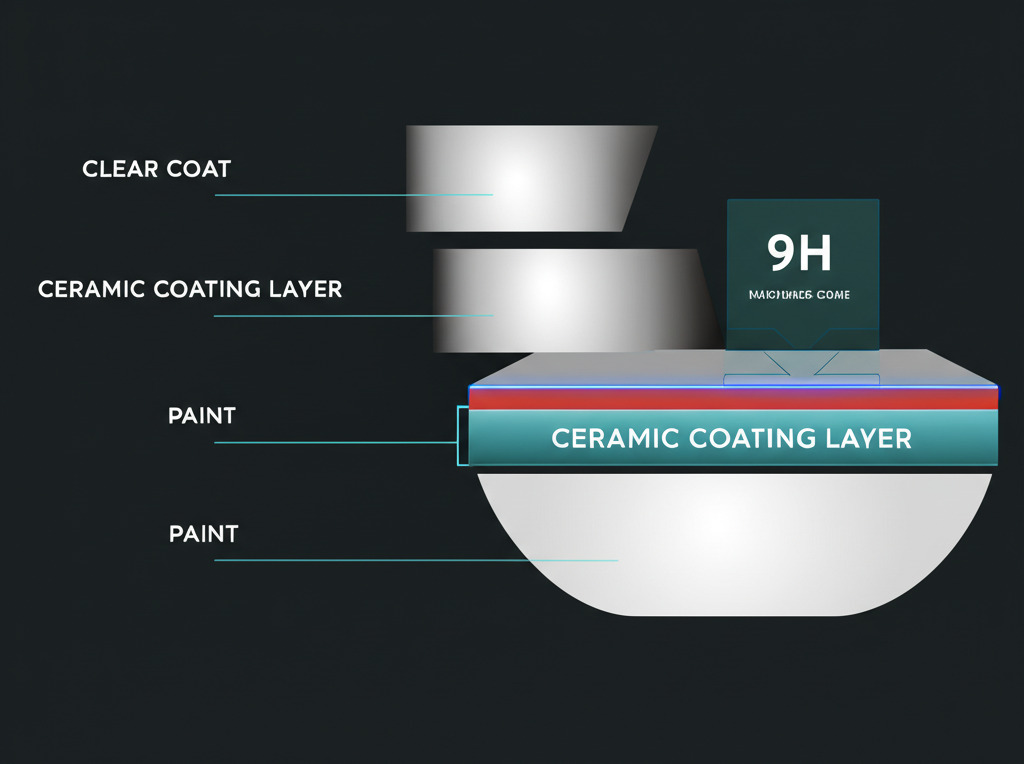
Understanding the actual testing process helps you see why these numbers deserve healthy scepticism. The [ASTM D3363 pencil hardness test](https://www.micomlab.com/micom-testing/astm-d3363/) is straightforward — even low-tech by modern standards.
The ASTM D3363 Process
A technician takes a set of graded pencils (6B through 9H), sharpens each to a flat edge, and draws them across the coated surface at a 45-degree angle under constant pressure. They start from the softest pencil and work upward. The hardest pencil that doesn’t gouge or scratch the coating determines the hardness rating.
The Variables That Muddy the Results
Here’s what ASTM itself acknowledges: results can vary between labs when different pencil brands or batches are used. The coating’s cure time matters — the standard calls for testing at 25–38 microns thickness after a 7-day cure. On your car, the coating is thinner and the cure environment is less controlled. Temperature, humidity, and the technician’s hand pressure all introduce variability.
Information Gain: The ASTM D3363 test was designed for industrial coatings on metal substrates — think factory floors and machinery, not Maruti Suzuki bonnets. Its application to automotive ceramic coatings is an adaptation, not the original intent.
Third-Party vs Self-Reported
The most trustworthy hardness claims come from independent, third-party labs like SGS, Intertek, or Bureau Veritas. If a brand only shows you their own internal test results, that’s a red flag. Ask for the lab name, test date, and certificate number. Legitimate manufacturers are happy to share this. Companies relying on inflated claims tend to get vague fast.
—
What Matters More Than Hardness Rating
If 9H is just a minimum bar that most decent ceramic coatings clear, then what should you actually evaluate? According to coating chemists and independent detailers, several factors predict real-world performance far better than a pencil test number.
SiO2 Concentration
Silicon dioxide is the active ingredient in ceramic coatings. Professional-grade formulas typically contain 80–97% SiO2, while consumer spray products may contain as little as 10–15%. Higher concentrations generally mean better bonding, longer durability, and stronger hydrophobic performance. But there’s a catch — excessively high SiO2 can make a coating brittle, so formulation balance matters.
Citation Capsule: Professional ceramic coatings typically use SiO2 concentrations of 80–97%, while consumer-grade products may contain 10–15%. Higher SiO2 doesn’t automatically mean better quality, as formulation balance affects brittleness and bonding. — [Opti-Coat](https://opticoat.com/blogs/news/sic-ceramic-coating-vs-sio2-ceramic-coating-whats-best-for-your-car); [TopCoat Products](https://topcoatproducts.com/blogs/blog/the-hype-around-sio2-what-is-it-is-it-really-ceramic)
Layer Thickness and Application Method
A single coat of even the best formula won’t match the performance of a properly applied multi-layer system. Each layer adds depth, cross-linking potential, and redundancy against wear. Professional application in a controlled, dust-free environment is non-negotiable for maximum performance. India’s dust levels make this especially relevant — a coating applied in an open workshop in Delhi’s summer is starting life compromised.
Surface Preparation
This is the silent dealmaker. A coating applied over swirl-marked, contaminated paint won’t bond properly, regardless of its hardness rating. Paint correction, clay bar decontamination, and panel wipe-down with IPA (isopropyl alcohol) must happen before the first drop of coating touches your car. Skip this step and you’ve locked imperfections under glass.
Brand Reputation and Warranty Backing
Does the brand offer a transferable warranty? Do they require certified installer application? Can they point to years of real-world performance data? In India’s growing ceramic coating market — part of an Asia-Pacific segment projected to hold [over 48% of global market share by 2026](https://www.alliedmarketresearch.com/high-performance-ceramic-coatings-market) — there’s no shortage of new entrants making big claims with little track record.
—
How to Evaluate Ceramic Coating Quality Beyond the H Rating
So you’ve decided to invest in a ceramic coating. Here’s a practical checklist that goes well beyond the hardness number printed on the box.
What to Look For
- Published SiO2 percentage on the technical data sheet or SDS (Safety Data Sheet)
- Third-party lab certifications — ask for specific lab names and certificate numbers
- Documented hydrophobic contact angle — quality coatings typically achieve 110+ degrees
- Clear warranty terms that specify what’s covered and what voids the warranty
- Installer certification requirements — brands that let anyone apply their product may not take quality seriously
Red Flags to Watch
- Any claim above 9H hardness (the ASTM scale doesn’t go higher)
- “Lifetime” warranties with vague terms and no maintenance requirements
- No mention of SiO2 concentration anywhere in product literature
- Reluctance to provide third-party test results when asked
- Pricing that seems too good to be true — professional ceramic coatings cost what they cost because of chemistry, not markup
Information Gain: A useful litmus test — email the brand’s technical support and ask for their ASTM D3363 test certificate from a named laboratory. The speed and specificity of their response tells you everything about whether their hardness claims are backed by science or just sales copy.
Do you really want to trust your car’s paint to a brand that can’t answer a simple technical question?
—
Frequently Asked Questions
Is 9H ceramic coating scratch-proof?
No. A 9H ceramic coating is scratch-resistant, not scratch-proof. It resists light surface scratches and swirl marks better than uncoated paint, wax, or sealants. But it can’t prevent damage from rock chips, key scratches, or heavy abrasion. The 9H rating only means it passed a pencil hardness test under controlled lab conditions — not that your car is invulnerable to real-world hazards.
What’s the difference between 9H and 10H ceramic coating?
The ASTM D3363 pencil hardness scale officially maxes out at 9H. There’s no standardised 10H pencil or recognised testing protocol for it. Brands advertising 10H, 12H, or higher are using numbers that don’t correspond to any internationally accepted standard. The practical performance difference between two coatings is determined by SiO2 content, formulation quality, and application technique — not by a made-up number.
Does 9H mean the same as 9 on the Mohs scale?
Absolutely not. The pencil hardness scale and the Mohs mineral hardness scale are entirely different systems. A 9H pencil hardness rating translates to roughly a 3 on the Mohs scale — equivalent to calcite. Mohs 9 is sapphire, and Mohs 10 is diamond. No ceramic coating comes anywhere close to sapphire-level hardness. Confusing these two scales is the single biggest source of customer misunderstanding in the coating industry.
How long does a 9H ceramic coating last?
A professionally applied 9H ceramic coating typically lasts 2–5 years, depending on the specific product, number of layers, environmental conditions, and how well you maintain it. In Indian conditions — intense UV, monsoon rains, road dust, and hard water — proper maintenance including pH-neutral washes and periodic top-ups is necessary to get the full lifespan. No coating lasts forever, regardless of its hardness rating.
Is a higher hardness rating always better?
Not necessarily. Hardness is just one property of a coating. An extremely hard but brittle coating may crack under thermal cycling or flex poorly on body panels. What matters more is the overall formulation — how the coating bonds to paint, its chemical resistance, UV stability, and hydrophobic performance. A well-balanced 7H coating from a reputable brand can outperform a poorly formulated product claiming 9H in real-world conditions.
—
Conclusion
The 9H rating on a ceramic coating tells you one thing: it passed a pencil scratch test. That’s genuinely useful information, but it’s a fraction of the story. It doesn’t tell you about chemical resistance, UV blocking, hydrophobic performance, longevity, or how the coating will handle Indian roads, weather, and washing habits.
Don’t let a single number — especially one that maxes out the existing scale — become your only buying criterion. Ask about SiO2 concentration. Demand third-party test certificates. Evaluate the brand’s track record, the installer’s training, and the warranty’s fine print. That’s how you make a smart investment in paint protection.
The best coating for your car isn’t the one with the biggest number on the label. It’s the one with the best science behind it, applied by someone who knows what they’re doing, on paint that’s been properly prepared.
Want to compare coating hardness ratings at a glance? [Download our free Coating Hardness Comparison Chart →](#download-hardness-chart) — it breaks down pencil hardness vs Mohs scale, lists popular brands with their verified ratings, and gives you the questions to ask any detailer before you commit.


