
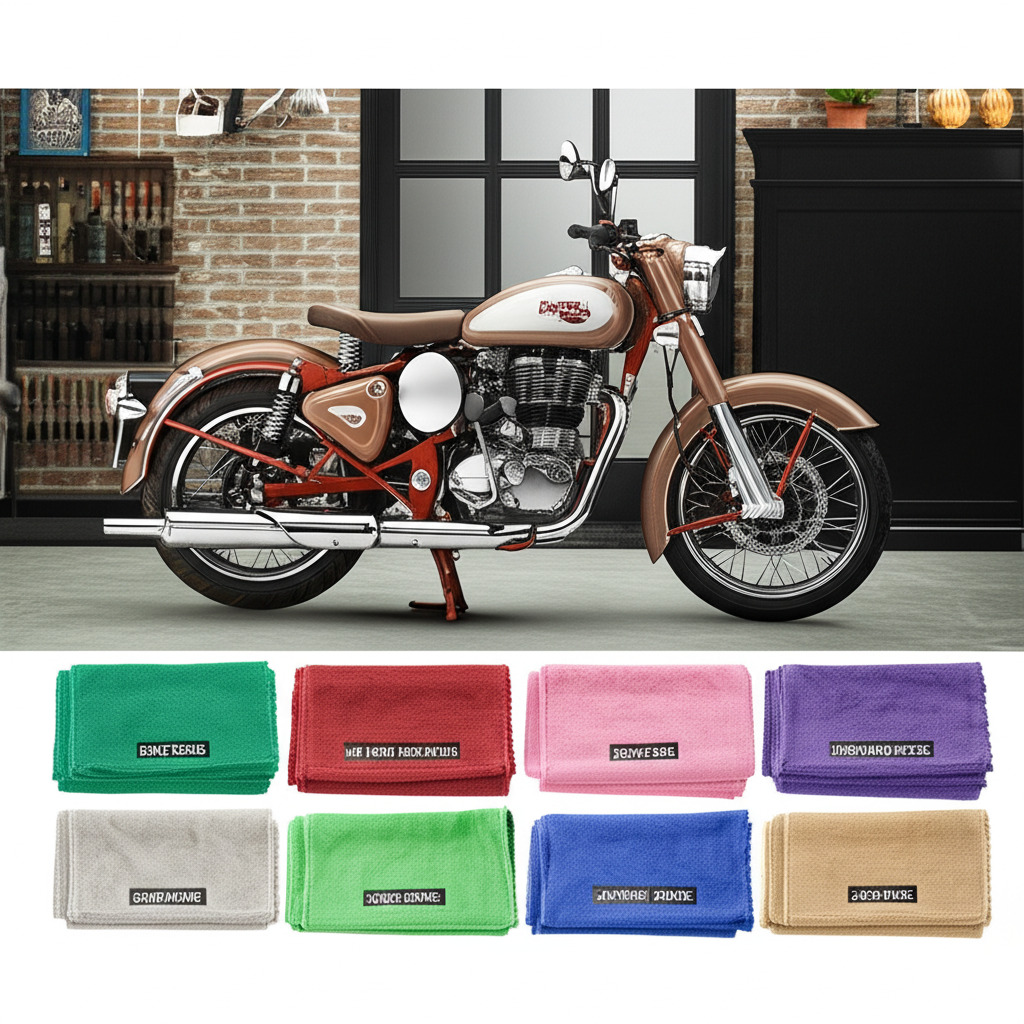
Microfiber Cloth for Bike: Complete Guide for Motorcycle Detailing
Using the same microfiber cloth for your bike’s tank and chain? That’s how you scratch ₹2 lakh of paintwork.
India has over 271 million registered two-wheelers on the road, and yet most riders grab a single rag — sometimes an old cotton t-shirt — for every cleaning job from chain lube wipe-down to tank polishing. Your motorcycle’s painted panels are thinner and more exposed than a car’s. The finish on a Royal Enfield Classic 350 or a KTM 390 Duke didn’t come cheap, and one cross-contaminated cloth can leave swirl marks you’ll notice every single ride. A proper microfiber cloth for bike detailing isn’t a luxury. It’s the most affordable protection you can give your motorcycle’s finish.
TL;DR: Choose 300-400 GSM microfiber for general bike cleaning and 600+ GSM for tank and fairing polish. Go with smaller sizes (30×30 cm or 30×40 cm) for better control around curves. Use a color-coding system — minimum four cloths — to avoid cross-contamination between painted surfaces, chrome, chain, and exhaust areas.
Why Motorcycles Need Different Microfiber Than Cars
India’s two-wheeler market hit 20.7 million sales in 2025, a testament to how deeply motorcycles are woven into daily life ([Autocar India](https://www.autocarindia.com/bike-news/two-wheeler-sales-cross-20-million-mark-in-438709)). But while the car detailing world has matured, motorcycle-specific cleaning advice remains surprisingly thin. Here’s why your bike demands a different approach to microfiber.
Smaller, curvier panels. A car bonnet is a wide, flat expanse. A motorcycle tank is a compound curve with tight edges near the seat and knee recesses. Large 40×60 cm cloths bunch up and drag across surfaces unevenly. You need smaller cloths — 30×30 cm or 30×40 cm — that wrap around contours without folding over themselves.
Engine heat zones. After a ride, your engine cases, exhaust headers, and sometimes even the lower fairing can be hot enough to melt low-quality microfiber. Standard polyester-blend cloths start deforming above 120°C. For areas near the exhaust, you need a cloth rated for higher heat exposure, or simply wait for cool-down.
Chain grease and road grime. Indian roads throw everything at your bike — oil, tar, gravel dust, and monsoon mud. The chain area collects the worst of it. If you use a cloth near the chain and then wipe your tank, those embedded grit particles become sandpaper on paint. Dedicated cloths for dirty zones aren’t optional — they’re mandatory.
More exposed surfaces. Unlike a car, your motorcycle exposes chrome, bare aluminium, rubber, painted plastic, and glass — all within arm’s reach of each other. Each surface has different scratch sensitivity. Chrome can handle a stiffer cloth; your windscreen or visor can’t. What works for one surface will damage another.
Citation Capsule: The India car and bike care products market was valued at USD 316.8 million in 2023 and is projected to grow at a CAGR of 4.7% through 2030 ([Grand View Research](https://www.grandviewresearch.com/industry-analysis/india-car-bike-care-products-market-report)). Two-wheeler owners are a major driver of this growth.
Key Buying Criteria for Bike Microfiber Cloth
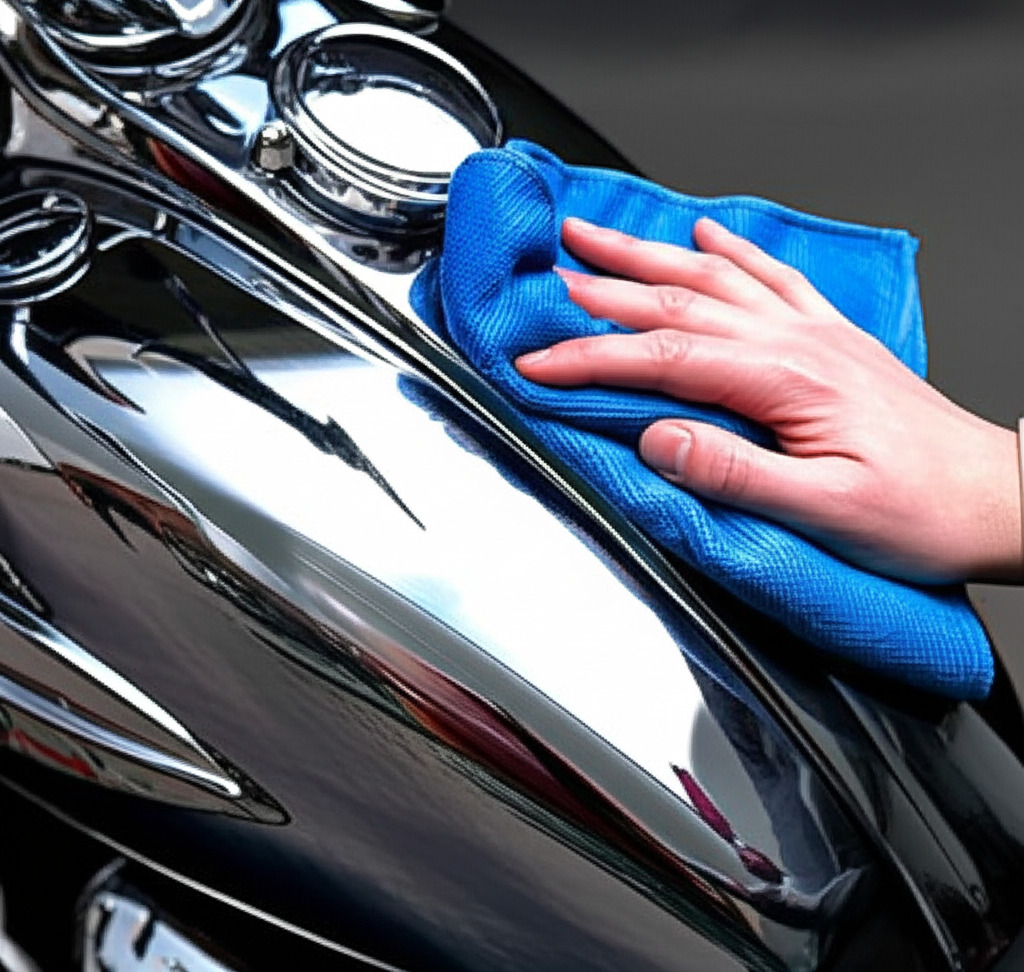
With the premium motorcycle segment growing at over 16% year-on-year — Royal Enfield alone sold a record 10.7 lakh bikes in 2025 ([Autocar India](https://www.autocarindia.com/bike-news/royal-enfield-sales-in-india-surpass-1-million-units-in-438878)) — more riders than ever are investing in proper maintenance. Here’s what to look for when picking a motorcycle cleaning cloth.
Size: Smaller Is Better
For motorcycles, ditch the large car-sized towels. A 30×30 cm cloth fits perfectly around tank curves, under seats, and between fairings. Go up to 30×40 cm for drying after a wash. Anything bigger becomes unwieldy and increases the risk of the cloth touching a dirty surface accidentally.
GSM (Grams Per Square Meter)
GSM measures cloth density and softness. Here’s your cheat sheet:
- 200-350 GSM: Good for engine cases, chain area, wheels, and general grime removal. Thinner, more control, easy to wring out.
- 350-450 GSM: All-purpose sweet spot. Works for most painted surfaces during quick detailer wipe-downs.
- 500-700 GSM: The plush zone. Use these for final buffing on tank, fairings, and any painted surface where swirl marks matter.
Weave Type
- Terry weave: Versatile, good absorption, works for most tasks.
- Waffle weave: Best for drying — pulls water off surfaces without dragging. Great for post-wash on fairings.
- Suede/flat weave: Ideal for glass, visors, and instrument clusters. Low pile means no lint.
Edge Type
Look for cloths with silk or microfiber-bound edges rather than stitched polyester borders. Hard edges catch on emblems, mirror stems, and raised decals — all common on motorcycles. A silk border glides over these without snagging.
Heat Resistance
If you’re wiping down engine cases or areas near the exhaust, choose a cloth with a higher polyamide (nylon) content. An 80/20 polyester-to-polyamide blend handles moderate heat better than a 70/30 blend. But the real answer? Let the bike cool for 15-20 minutes before detailing near the engine.
Best Microfiber Cloths for Motorcycle Detailing
With two-wheeler registrations crossing 2 crore units in 2025 alone ([CEIC Data](https://www.ceicdata.com/en/india/number-of-registered-motor-vehicles/registered-motor-vehicles-two-wheelers)), the demand for quality bike care products has never been higher. Here’s how the top options compare.
Comparison Table
| Feature | Motor Headz Duo Weave | Competitor A (Generic 300 GSM) | Competitor B (Imported 600 GSM) |
|—|—|—|—|
| GSM | 400 / 600 (dual pack) | 300 | 600 |
| Size | 30×30 cm & 30×40 cm | 40×40 cm | 40×60 cm |
| Weave | Terry + Waffle combo | Terry only | Terry only |
| Edge | Silk-bound | Stitched polyester | Stitched microfiber |
| Blend | 80/20 polyester/polyamide | 80/20 | 70/30 |
| Price (approx.) | ₹349 (4-pack) | ₹199 (3-pack) | ₹699 (2-pack) |
| Bike-specific sizing | Yes | No | No |
Motor Headz Duo Weave Pack
Built specifically for two-wheeler owners. The 30×30 cm size is purpose-made for motorcycle panels — you won’t fight with excess fabric around mirrors and fork tubes. The dual GSM option means you get a workhorse cloth for general cleaning and a plush cloth for final buffing in the same pack.
Generic 300 GSM Cloths
Available widely on Amazon and Flipkart. They work for budget-conscious riders, but the 40×40 cm size is awkward on bikes, and stitched edges snag on Royal Enfield tank badges and KTM decals. Fine for wheels and underbody, not ideal for paint.
Imported High-GSM Cloths
Premium quality, but oversized for motorcycle work and overpriced. The 40×60 cm size is designed for car bonnets, not bike tanks. You’ll end up folding them down anyway, which defeats the purpose of even plushness.
Information Gain: Most “bike microfiber” products sold in India are actually car cloths repackaged. True motorcycle-specific sizing starts at 30×30 cm — small enough to navigate between a Yamaha R15’s twin headlamp assembly or around a Bajaj Dominar’s tank shrouds without bunching.
Size Recommendations by Bike Area
- Tank & fairings: 30×40 cm, 500+ GSM
- Wheels & swingarm: 30×30 cm, 300 GSM
- Chain & sprocket wipe: 30×30 cm, 200-300 GSM (dedicated, never reuse on paint)
- Visor & instrument cluster: 20×20 cm or 30×30 cm, suede/flat weave
- Exhaust & engine cases: 30×30 cm, 300-400 GSM (after cool-down)
Color-Coding System for Motorcycle Detailing
Professional detailers don’t guess which cloth touched which surface — they colour-code. With motorcycles selling over 20 million units annually in India ([MotorCyclesData](https://www.motorcyclesdata.com/2026/01/02/indian-motorcycles-market/)), more riders are adopting pro-level habits at home. Here’s a five-colour system that works.
| Colour | Assigned Area | Why |
|—|—|—|
| Blue | Tank, fairings, painted panels | Highest sensitivity — reserved for paint only |
| Yellow | Chrome, aluminium, metal trim | Different polish residues than paint |
| Red | Chain, sprocket, lower engine | Dirtiest zone — never crosses over |
| Green | Windscreen, visor, instrument cluster | Lint-free suede weave preferred |
| Grey/Black | Exhaust, engine cases, heat zones | Gets stained quickly; dark colour hides it |
Why does this matter? Because cross-contamination is the number one cause of swirl marks on motorcycle paint. Chain lube contains metal particles. Exhaust soot is abrasive. Chrome polish residue can cloud clear plastic. One wrong wipe and your Yamaha MT-15’s gloss black tank looks like it survived a sandstorm.
Keep each colour in a separate zip-lock bag after washing. Label the bags. It takes 30 seconds and saves you a repaint that could cost ₹5,000-₹15,000 depending on the panel.
Information Gain: Unlike cars, where you might get away with three dedicated cloths (paint, glass, wheels), motorcycles benefit from a five-cloth system because of the chain, exposed engine, and exhaust — surfaces that simply don’t exist in the same way on a car.
How to Detail Your Motorcycle with Microfiber: Step-by-Step
The premium 250cc+ motorcycle segment now accounts for over 24% of total motorcycle sales in India ([Autocar Professional](https://www.autocarpro.in/analysis/royal-enfield-emerges-as-indias-fastest-growing-traditional-motorcycle-brand-in-h1-2025-127389)), and owners of these bikes expect showroom-level finishes. Here’s how to get there with nothing more than proper technique and the right microfiber cloths.
Step 1: Cool Down (5-15 Minutes)
Never detail a hot bike. Park in shade and let the engine, exhaust, and disc brakes cool. Hot surfaces cause cleaning products to flash-dry, leaving streaks and residue that bond to the finish.
Step 2: Rinse Off Loose Dirt
Use a low-pressure hose or bucket to wash off surface dust and mud. This removes the large particles that would otherwise drag across paint during wiping. Skip this step at your own risk — especially during monsoon season when road grime contains sand.
Step 3: Wash with Two-Bucket Method
One bucket has soapy water, the other has clean rinse water. Dip your blue microfiber into soapy water, wash a painted panel, then rinse the cloth in the clean bucket before reloading with soap. This keeps grit out of your wash solution.
Step 4: Dry with Waffle Weave
Pat dry — don’t drag. A waffle-weave cloth in 30×40 cm size absorbs water quickly without creating friction. Start from the tank (cleanest area) and work downward.
Step 5: Detail Specific Zones
- Chrome (yellow cloth): Apply chrome polish, buff gently in straight lines, never circles.
- Visor and screen (green cloth): Mist with glass cleaner, wipe with suede microfiber. Circular motions are fine here since you’re not dealing with soft clear coat.
- Chain area (red cloth): Wipe excess chain lube and grime. This cloth goes straight into a separate wash pile.
- Exhaust (grey cloth): Once cool, wipe with a damp microfiber to remove water spots and discoloration.
Step 6: Final Buff on Paint
Fold your blue 600 GSM cloth into quarters. Buff the tank and fairings with light, straight-line passes. Flip to a clean side every few passes. This is where the plush GSM pays for itself — zero marring, pure gloss.
Common Motorcycle Microfiber Mistakes
Haven’t you noticed how some bikes at weekend meetups look worse after a “detail” than before? Here are the mistakes that cause it — and they’re all avoidable.
Using microfiber on a hot exhaust. This is the most common blunder. Your Bajaj Pulsar’s exhaust header can exceed 300°C after a ride. Pressing a microfiber cloth onto it doesn’t clean — it melts polyester fibers onto the metal, creating a bonded mess that needs abrasive removal. Always wait for cool-down.
Chain cloth touching painted surfaces. Chain lube contains microscopic metal shavings from wear. One accidental wipe on your tank and you’ve embedded metal particles into the clear coat. This is permanent damage. Colour-code religiously.
Wrong size creating drag marks. A 40×60 cm cloth folded in half still hangs off a motorcycle tank. The excess fabric drags across the seat, side panels, or worse — the chain guard. That trailing edge picks up grit and delivers it straight to your paint on the next pass.
Skipping the rinse after monsoon rides. Monsoon road water in Indian cities carries oil, sewage residue, and industrial runoff. Wiping this off with a dry microfiber grinds contaminants into the finish. Always rinse first.
Never washing the microfiber cloths. A dirty microfiber is worse than a cotton rag. Wash after every 2-3 uses in cold water without fabric softener. Softener clogs the fibres and kills absorbency.
Citation Capsule: The bike cleaning products segment is one of the fastest-growing categories within the Indian vehicle care market, driven by the increasing number of two-wheeler owners focused on maintenance ([Archive Market Research](https://www.archivemarketresearch.com/reports/india-car-and-bike-care-products-market-8871)).
Frequently Asked Questions
What GSM microfiber cloth is best for bike cleaning?
For general motorcycle cleaning, 350-450 GSM offers the best balance of softness and control. For final buffing on painted panels like your tank and fairings, step up to 600+ GSM. For wheels, chain area, and engine cases, 200-300 GSM works fine since these surfaces aren’t scratch-sensitive in the same way paint is.
Can I use the same microfiber cloth for my car and bike?
Technically, yes — the material is the same. But car-sized cloths (40×60 cm) are too large for motorcycle work. They bunch up around curves, drag across multiple surfaces, and make precision detailing nearly impossible. You’re better off with 30×30 cm or 30×40 cm cloths sized specifically for two-wheelers.
How often should I replace microfiber cloths for bike detailing?
A quality microfiber cloth lasts 200-300 washes if cared for properly — cold water, no fabric softener, air dry or tumble dry on low heat. Replace when the cloth feels stiff, loses absorbency, or shows visible matting. For chain-duty cloths (the red ones), expect a shorter lifespan of 50-100 washes due to grease buildup.
Is microfiber safe for Royal Enfield chrome parts?
Absolutely. Use a mid-range GSM cloth (300-400) with chrome-specific polish. The key is to work in straight lines, not circles, and to use a dedicated cloth that hasn’t touched painted surfaces. Chrome polish residue can haze clear-coated paint, so keeping a separate yellow cloth for chrome is worth the effort.
How do I clean microfiber cloths after bike detailing?
Separate your cloths by colour group. Wash chain and engine cloths (red, grey) separately from paint and glass cloths (blue, green). Use cold or lukewarm water with a mild liquid detergent — no powder detergent, no fabric softener, no bleach. Air dry in shade. Sunlight can degrade the polyester fibres over time.
Final Recommendation: Start with a Proper Bike Care Bundle
India’s motorcycle market isn’t slowing down — it’s projected to reach USD 37.3 billion by 2030 ([Mordor Intelligence](https://www.mordorintelligence.com/industry-reports/india-two-wheeler-market)). That means more premium bikes on Indian roads, more riders who care about finish quality, and more demand for products that actually work for two-wheelers instead of being car accessories sold with a “works for bikes too” sticker.
If you’re starting from zero, don’t buy cloths one at a time. You need at least four dedicated microfiber cloths — one for paint, one for chrome, one for glass, and one for the dirty zones. A proper bundle gives you the right sizes, the right GSMs, and a colour-coding system from day one.
Information Gain: Most Indian riders spend ₹200-₹500 yearly on cleaning cloths but lose ₹2,000-₹10,000 in paint correction from using the wrong ones. The math is simple — invest in proper microfiber upfront.
The Motor Headz Bike Care Bundle includes five colour-coded microfiber cloths in motorcycle-specific sizes (30×30 cm and 30×40 cm), ranging from 300 to 600 GSM, with silk-bound edges that won’t snag on your bike’s badges or decals. It’s designed by riders, for riders — because your Dominar, Classic, or Apache deserves better than an old cotton t-shirt.
Ready to stop guessing and start detailing properly? [Grab the Motor Headz Bike Care Bundle →](/shop/bike-care-bundle) and give your motorcycle the microfiber it actually needs. Free shipping across India on orders above ₹499.


